
What Is Two Week IVF? Fast-Tracking Fertility Success

Long waits and repeated appointments can leave you feeling frustrated when all you want is progress toward your dream of motherhood. For women under 40 with a strong ovarian reserve in North America, finding fertility care that prioritizes speed, affordability, and personal attention is a game changer. This guide clarifies the fast-tracked treatment pathway of Two Week IVF, highlights what truly sets it apart, and dispels misconceptions so you can make confident decisions about your fertility journey.
Table of Contents
Key Takeaways
Point | Details |
Two Week IVF Accelerates Treatment | The Two Week IVF process compresses the entire fertility treatment timeline into approximately 14 days, streamlining multiple steps using AI technology. |
Myths vs. Reality | Common misconceptions about speed affecting safety, side effects, or success rates are debunked; faster cycles can maintain or even improve outcomes. |
Cost-Effective Option | Two Week IVF typically costs between $6,000 and $12,000 per cycle, significantly less than traditional IVF, providing a more affordable alternative. |
Eligibility Requirements | Ideal candidates for Two Week IVF are generally women under 40 with good ovarian reserves and regular cycles, ensuring a tailored approach to treatment. |
Defining Two Week IVF And Core Misconceptions
Two Week IVF is not a single procedure—it’s a fast-tracked treatment pathway that compresses the traditional multi-month fertility process into roughly 14 days from start to pregnancy testing. Instead of waiting weeks between appointments and tests, you move through stimulation, egg retrieval, embryo development, and transfer in an accelerated timeline.
The term “two week” actually refers to the post-transfer waiting period, the timeframe from when an embryo is transferred until you can take a pregnancy test. But modern rapid IVF clinics like Aurea Fertility compress the entire cycle before that waiting period even begins.
What Makes Two Week IVF Different
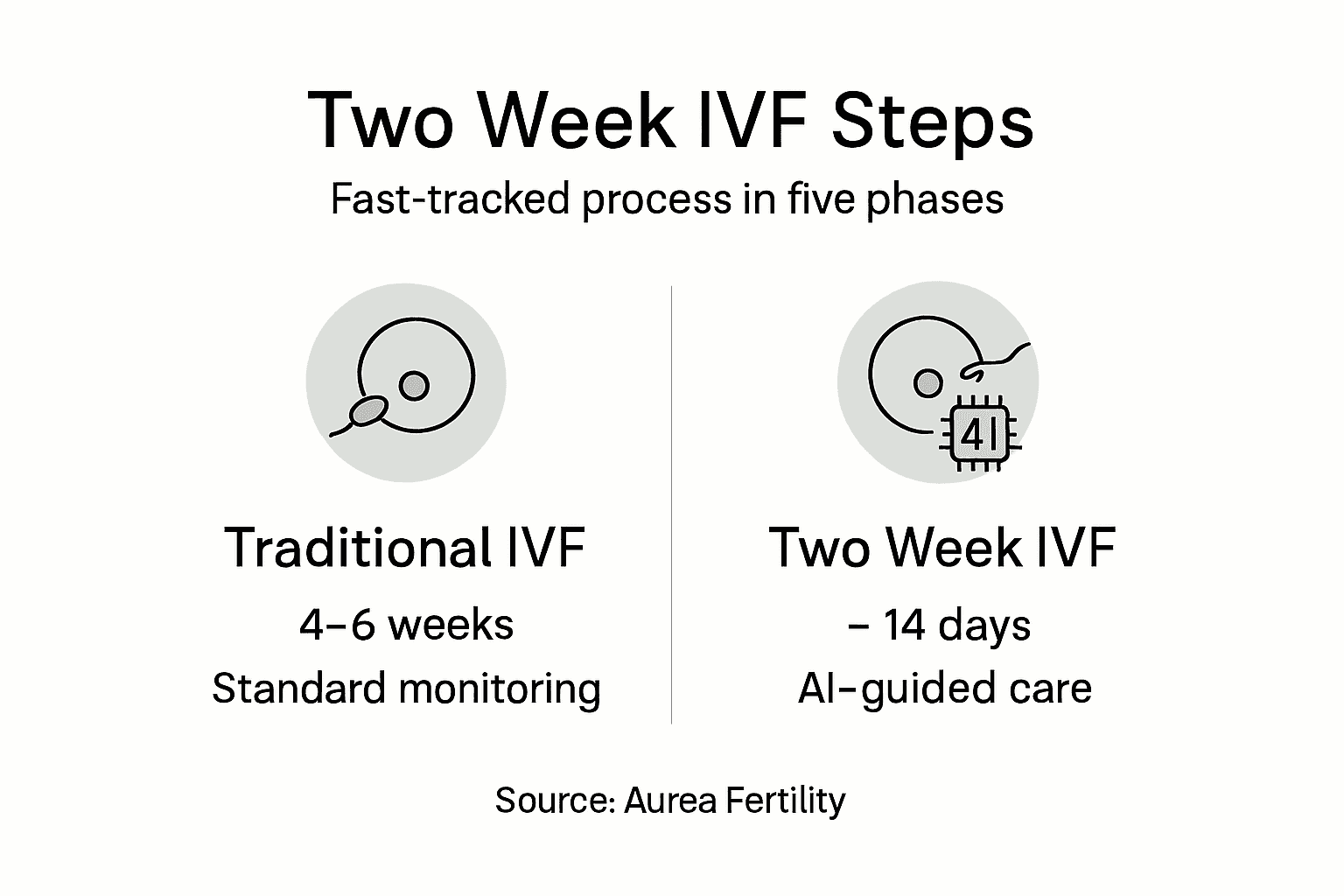
Traditional IVF typically takes 4-6 weeks or longer. Two Week IVF achieves speed through three key changes:
AI-driven decision making eliminates unnecessary testing and waiting periods
Streamlined protocols remove redundant appointments and delays
Personalized pacing matches your cycle to optimal timing, not arbitrary schedules
You’re not rushing the science—you’re eliminating the waiting.
Common Misconceptions
Misunderstanding what Two Week IVF actually is can set unrealistic expectations. Here are the biggest myths:
Myth 1: Faster means less safe. Two Week IVF uses the same medical standards and safety protocols as traditional IVF. Speed comes from eliminating redundancy, not cutting corners.
Myth 2: You’ll experience more side effects. The timeline is compressed, not the medication dosages. Side effects depend on your individual response to hormones, not treatment speed.
Myth 3: Success rates drop with speed. Research shows success depends on embryo quality and uterine readiness, not how long the overall cycle takes. For women under 40 with good ovarian reserve, faster pathways can actually improve outcomes by reducing stress-related delays.
Myth 4: The two-week wait feels shorter. The emotional intensity of waiting for pregnancy results remains the same regardless of how quickly you reached that point.
Two Week IVF removes scheduling delays, not medical steps—it’s precision timing, not corner-cutting.
Understanding what Two Week IVF actually is prevents disappointment and helps you approach treatment with accurate expectations about timelines, outcomes, and what to expect emotionally.
Pro tip: Ask your clinic specifically which steps in their protocol are streamlined versus standard—this clarity helps you understand exactly why their timeline differs from traditional IVF programs.
How Two Week IVF Differs From Traditional IVF
The primary difference lies in timeline compression. Traditional IVF follows a standard multi-week protocol with controlled ovarian stimulation lasting 10-14 days, followed by monitoring, retrieval, fertilization, and embryo development before transfer. Two Week IVF accelerates this entire process by eliminating unnecessary waiting periods and streamlining decision-making through artificial intelligence.
Traditional IVF requires prolonged hormone injections to gradually develop multiple follicles over weeks, with frequent ultrasound monitoring and blood work. Two Week IVF uses AI-driven protocols that identify your optimal response faster, reducing redundant appointments and medication adjustments.
Key Timeline Differences
Here’s how the calendars compare:
Here’s a summary of major differences between Two Week IVF and traditional IVF:
Aspect | Two Week IVF | Traditional IVF |
Timeline | 2 weeks total | 4–6+ weeks total |
Appointment Frequency | Minimal, only essential visits | Multiple, frequent check-ins |
Protocol Design | AI-driven and personalized | Standardized and manual |
Cost per cycle (USD) | $6,000–$12,000 | $12,000–$25,000 |
Stress Level | Short-term, more focused | Prolonged, extended over months |
Ideal Candidates | Under 40, good ovarian reserve | Broad, but timing may vary |
Traditional IVF: 4-6+ weeks from consultation to pregnancy test
Two Week IVF: 2 weeks from initial appointment to pregnancy test
Traditional monitoring: Multiple ultrasounds and blood tests over 2-3 weeks
Two Week IVF monitoring: Precision testing focused only on essential data points
Why Speed Is Possible
Two Week IVF doesn’t skip medical steps—it eliminates waiting. Controlled ovarian stimulation protocols remain medically sound, but AI predicts your response patterns within days rather than weeks. This precision reduces the guesswork that traditionally causes delays.
You still receive the same medication dosages and quality of care. The difference is that your clinic uses data analytics to time your trigger shot and retrieval exactly when your follicles are ready, not on a predetermined schedule.
What Remains the Same
Don’t mistake speed for shortcuts. Both traditional and Two Week IVF include:
Complete hormone stimulation cycles
Egg retrieval under anesthesia
Embryo fertilization and development
Embryo transfer to the uterus
The post-transfer two-week waiting period
Two Week IVF compresses scheduling delays, not medical rigor—every clinical step remains unchanged.
The emotional experience differs significantly. Traditional IVF stretches anticipation over weeks of appointments and uncertainty. Two Week IVF condenses this into a focused, high-clarity experience where you know exactly what to expect each day.
Pro tip: Ask your clinic to map out their specific timeline day-by-day so you understand exactly when each step occurs—this clarity helps you prepare emotionally and logistically for the compressed schedule.
Key Steps In The Two Week IVF Process
Two Week IVF moves through five distinct phases in rapid succession. Each step builds on the previous one, with AI-driven monitoring ensuring you progress exactly when your body is ready, not on a predetermined calendar.
Phase 1: Ovarian Stimulation
Your cycle begins with hormone injections that signal your ovaries to develop multiple follicles simultaneously. Traditional IVF stretches this over 10-14 days with multiple monitoring appointments. Two Week IVF uses AI algorithms to track your response from day one, identifying the exact moment your follicles reach optimal maturity.

You’ll likely inject hormones for 7-10 days, but your clinic monitors continuously to time everything precisely.
Phase 2: Egg Retrieval
When your follicles are perfectly developed, you receive a trigger injection to finalize egg maturation. Thirty-six hours later, your eggs are retrieved under light anesthesia in an outpatient procedure lasting 15-20 minutes. No overnight hospital stay required.
This precision timing is where Two Week IVF saves crucial days compared to traditional protocols.
Phase 3: Fertilization and Embryo Culture
Your retrieved eggs are fertilized in the laboratory using your partner’s sperm or donor sperm. The IVF process then includes embryo culture, where embryos develop for 5-6 days while AI-assisted monitoring tracks their growth and quality continuously.
Unlike traditional clinics that check embryos once or twice daily, advanced monitoring systems provide real-time data on development patterns.
Phase 4: Embryo Transfer
Your best-quality embryo is transferred directly into your uterus. Preparing for embryo transfer requires a specific uterine lining thickness and hormonal environment—two factors AI protocols optimize precisely before transfer day.
This is a quick, painless procedure performed in your clinic without anesthesia.
Phase 5: The Two-Week Wait
After transfer, implantation occurs over 6-12 days. You continue hormone support medications to sustain the uterine lining. Avoid early pregnancy testing; the two week wait requires patience until your beta-hCG blood test on day 10-14 post-transfer confirms pregnancy.
Each Two Week IVF step is medically identical to traditional IVF—compression comes from eliminated delays, not rushed science.
Pro tip: Understand each phase’s typical duration beforehand so unexpected delays don’t feel like treatment failure—knowing your clinic’s timeline helps you distinguish normal variation from actual concerns.
AI Technology And Personalized Protocols
Artificial intelligence is the engine that makes Two Week IVF possible. Rather than following a one-size-fits-all schedule, AI analyzes your individual data to customize every aspect of your treatment—from medication dosage to optimal timing for retrieval and transfer.
This personalization transforms fertility care from a standardized process into a precision medicine approach tailored specifically to your body’s response patterns.
How AI Customizes Your Protocol
Traditional IVF clinics adjust medications based on ultrasound scans and blood work performed every 2-3 days. AI-driven protocols monitor your response continuously, predicting optimal dosages and timing within hours rather than days.
Machine learning models analyze patient data to tailor medication dosage and timing, reducing guesswork and accelerating the entire cycle. Your protocol adapts in real-time based on how your follicles develop.
Key AI Applications in Two Week IVF
AI influences multiple critical decisions throughout your cycle:
The table below highlights key roles of AI in the Two Week IVF process:
AI Function | Impact on IVF Process | Patient Benefit |
Stimulation Optimization | Finds optimal hormone dosing quickly | Reduces side effects risk |
Trigger Timing | Identifies best retrieval moment | Maximizes egg quality |
Embryo Grading | Uses advanced imaging for accuracy | Improves selection success |
Protocol Personalization | Adapts to patient data in real-time | Treatment fits individual needs |
Stimulation optimization: Predicts your ideal hormone dosage within 24 hours of starting injections
Trigger timing: Determines the exact moment your follicles are perfectly mature for retrieval
Embryo grading: Uses advanced imaging to assess embryo quality more accurately than manual assessment
Implantation prediction: Evaluates uterine readiness and embryo viability to maximize transfer success
Treatment adjustments: Recommends protocol modifications based on your individual response patterns
Personalization Beyond Speed
Two Week IVF isn’t just faster—it’s smarter. AI-driven personalized IVF protocols analyze patient data and clinical parameters to customize stimulation protocols and predict embryo viability, reducing the trial-and-error approach that traditional clinics rely on.
Your age, hormone levels, ovarian reserve, and previous cycle history inform every decision. No two patients receive identical protocols, even when their basic profiles seem similar.
The Confidence Factor
AI-generated recommendations carry measurable certainty levels. Your clinic can tell you not just what to do, but how confident the system is in that recommendation based on similar cases.
This transparency helps you understand which decisions are flexible versus which are critical for your specific situation.
AI removes the waiting that traditionally slows fertility treatment—personalization accelerates care without sacrificing precision.
Pro tip: Ask your clinic to explain their AI model’s confidence score for key decisions like trigger timing and embryo selection—understanding the certainty behind recommendations helps you trust the accelerated timeline.
Costs, Risks, And Who Is Eligible
Two Week IVF costs significantly less than traditional IVF while offering faster results. Understanding pricing, eligibility criteria, and potential risks helps you make an informed decision about whether this treatment pathway fits your situation and budget.
Cost Comparison
Traditional IVF typically costs $12,000 to $25,000 per cycle in North America, with multiple cycles often required. Two Week IVF clinics reduce costs through efficiency—fewer appointments, streamlined testing, and optimized protocols mean lower overhead. Most rapid IVF clinics charge $6,000 to $12,000 per complete cycle, cutting typical expenses in half.
IVF costs can create significant financial burden for many families, making affordable alternatives increasingly important. Insurance coverage varies widely depending on your location and policy, though many plans offer limited IVF coverage.
Eligibility Requirements
Two Week IVF is optimized for specific patient profiles:
Age under 40 with good ovarian reserve
Regular menstrual cycles or manageable cycle irregularities
No significant uterine abnormalities preventing embryo transfer
Adequate egg quantity demonstrated by AMH testing
Basic health clearance for hormone stimulation and retrieval
Unlike some traditional programs, Two Week IVF clinics typically don’t impose strict BMI cutoffs or lengthy “time trying to conceive” requirements.
Medical Risks
Two Week IVF carries the same medical risks as traditional IVF—the accelerated timeline doesn’t increase complications:
Ovarian hyperstimulation syndrome (OHSS): Rare but serious; occurs when ovaries over-respond to hormones
Egg retrieval complications: Bleeding or infection at retrieval site (less than 1% of cases)
Multiple pregnancy: Transferring one embryo minimizes this risk significantly
Psychological stress: Compressed timeline reduces prolonged anxiety
AI-driven monitoring actually reduces OHSS risk by predicting your response and adjusting medications preemptively.
Emotional and Financial Realities
The speed advantage brings unexpected benefits beyond cost savings. Fewer appointment weeks means less time away from work, reduced childcare coordination, and lower emotional toll from prolonged uncertainty.
Many women report that the compressed timeline feels more manageable psychologically than months of traditional treatment.
Two Week IVF costs less and carries no additional medical risk—the trade-off is upfront commitment and time management during those two intensive weeks.
Pro tip: Ask your clinic for a complete cost breakdown before starting treatment, including all medications, monitoring, and retrieval fees—this prevents surprise expenses mid-cycle when you’re already emotionally invested.
Experience the Future of Fertility with Two Week IVF at Aurea Fertility
If you are seeking a faster, personalized, and trustworthy fertility solution Two Week IVF offers a groundbreaking pathway that compresses the traditional months-long treatment into just about two weeks. This approach focuses on removing waiting times while keeping every medical step safe and precise. At Aurea Fertility we understand the emotional and financial challenges you face in your fertility journey and provide AI-driven protocols that adapt to your unique cycle and needs. Our cutting-edge technology enhances embryo monitoring and optimizes each phase — from ovarian stimulation to embryo transfer.
Choosing Aurea means more than speed. It means compassionate care combined with innovative science tailored to improve your chances while reducing stress and costs. Ready to take control and fast-track your path to pregnancy Discover how Two Week IVF at Aurea Fertility can deliver personalized care and quick results without compromising safety. Learn more about our AI-driven fertility treatments and start your journey with experts who support you 24/7. Don’t wait months for answers act now and explore the future of fertility at Aurea Fertility.
Frequently Asked Questions
What is Two Week IVF?
Two Week IVF is a fast-tracked treatment pathway that condenses the traditional IVF cycle into roughly 14 days, from initial consultation to pregnancy testing, allowing for accelerated procedures like ovarian stimulation, egg retrieval, embryo development, and transfer.
How does Two Week IVF differ from traditional IVF?
Two Week IVF differs primarily in its timeline; it reduces the overall duration from 4-6 weeks or longer to about 2 weeks by eliminating unnecessary waiting periods and using AI-driven protocols for personalized treatment.
Are the safety protocols the same in Two Week IVF as in traditional IVF?
Yes, Two Week IVF adheres to the same medical standards and safety protocols as traditional IVF. The acceleration comes from streamlining processes rather than compromising safety measures.
What are the ideal candidates for Two Week IVF?
Ideal candidates for Two Week IVF are typically women under 40 with a good ovarian reserve, regular menstrual cycles, and no significant uterine abnormalities preventing embryo transfer.
Recommended


Comments