
Role of Technology in Fertility – Personalized, Faster Care
- Feb 11
- 8 min read

Choosing fertility care can feel overwhelming, especially for women seeking fast, reliable solutions that minimize stress. Technology is reshaping how clinics approach reproductive medicine, bringing AI-powered precision and truly personalized treatments to the forefront. Clinics across North America, Europe, and Asia are adopting data-driven methods that refine every step of the fertility process. This article explores how advanced tech tools and artificial intelligence are transforming patient outcomes, helping you find options designed for clarity, speed, and peace of mind.
Table of Contents
Key Takeaways
Point | Details |
Transformation of Fertility Care | Technology is revolutionizing fertility treatments by enhancing precision and personalization, using AI and data analytics to improve success rates. |
AI-Driven Insights | Artificial intelligence is streamlining embryo selection and treatment processes, significantly increasing the efficiency and effectiveness of reproductive healthcare. |
Diverse Technological Tools | A wide range of modern tech tools, including mobile applications and wearable devices, provide essential support throughout the fertility journey. |
Ethical and Financial Considerations | Advanced reproductive technologies come with important financial, ethical, and safety implications that require transparent practices and informed patient engagement. |
Defining Technology’s Impact on Fertility
Technology is fundamentally transforming fertility care, offering unprecedented precision and personalization for individuals seeking reproductive solutions. The landscape of assisted reproductive technology (ART) has evolved dramatically, moving beyond traditional methods to incorporate sophisticated artificial intelligence and data-driven approaches that enhance success rates and patient experiences.
Recent scientific research highlights the profound implications of technological advancements in reproductive medicine. Comprehensive global studies on ART demonstrate how emerging technologies are compensating for age-related fertility challenges, particularly in high-income countries with trends of delayed childbearing.
Key technological innovations are reshaping fertility treatments through several critical developments:
AI-powered embryo selection that increases implantation success rates
Genetic screening technologies enabling more precise genetic risk assessments
Advanced imaging techniques providing real-time reproductive health insights
Personalized treatment algorithms tailoring interventions to individual genetic profiles
The integration of artificial intelligence and machine learning represents a quantum leap in reproductive healthcare. These technologies enable clinicians to make more informed decisions by analyzing complex genetic, physiological, and historical patient data with unprecedented accuracy.
Pro tip: Research clinics that demonstrate measurable technological integration and can articulate their specific AI and machine learning protocols for fertility treatment.
AI and Data Analytics in Reproductive Treatments
Artificial intelligence and data analytics are revolutionizing reproductive medicine by transforming how fertility treatments are conceptualized, planned, and executed. Advanced data analytics in fertility care are enabling unprecedented precision in treatment protocols, moving beyond traditional one-size-fits-all approaches to truly personalized reproductive strategies.
The integration of AI technologies introduces multiple breakthrough capabilities in reproductive healthcare:
Predictive embryo viability assessment using machine learning algorithms
Genetic risk profiling with advanced computational analysis
Real-time treatment optimization through continuous data monitoring
Personalized hormonal stimulation protocols based on individual genetic markers
Modern reproductive clinics are leveraging data-driven decision making to dramatically improve patient outcomes. By analyzing vast datasets encompassing genetic information, hormonal profiles, and historical treatment responses, AI systems can generate remarkably accurate predictions about fertility potential and recommended interventions.
AI technologies are transforming reproductive medicine from a reactive to a proactive healthcare model, offering patients more targeted and efficient treatment pathways.
The potential of artificial intelligence extends beyond immediate treatment planning. These sophisticated technologies are creating comprehensive patient profiles that integrate complex biological, genetic, and environmental factors, enabling more nuanced and personalized fertility strategies.
Pro tip: Request detailed information about your clinic’s specific AI and data analytics protocols to understand how technology is being applied to your individual fertility journey.
Types of Tech Tools in Fertility Care
Modern fertility technologies are revolutionizing reproductive healthcare by providing patients with sophisticated digital tools that transform traditional approaches to fertility management. These innovative technologies span multiple domains, offering comprehensive support throughout the reproductive journey.
The landscape of fertility tech tools encompasses several critical categories:
Mobile tracking applications for menstrual and fertility cycle monitoring
Wearable biometric devices measuring hormonal and physiological indicators
Advanced genetic screening platforms for comprehensive genetic risk assessment
AI-powered diagnostic imaging systems
Real-time hormonal analysis tools
Each technological category serves a unique purpose in the fertility ecosystem. Tracking applications, for instance, enable precise ovulation prediction and fertile window identification, while wearable devices provide continuous physiological data that can help individuals understand their reproductive health more comprehensively.
Digital fertility technologies are transforming patient experiences by democratizing access to sophisticated reproductive health insights.
Advanced reproductive technologies go beyond simple tracking, integrating complex machine learning algorithms that can predict fertility potential, analyze genetic markers, and provide personalized treatment recommendations. These tools represent a significant leap from traditional diagnostic methods, offering unprecedented levels of precision and personalization.
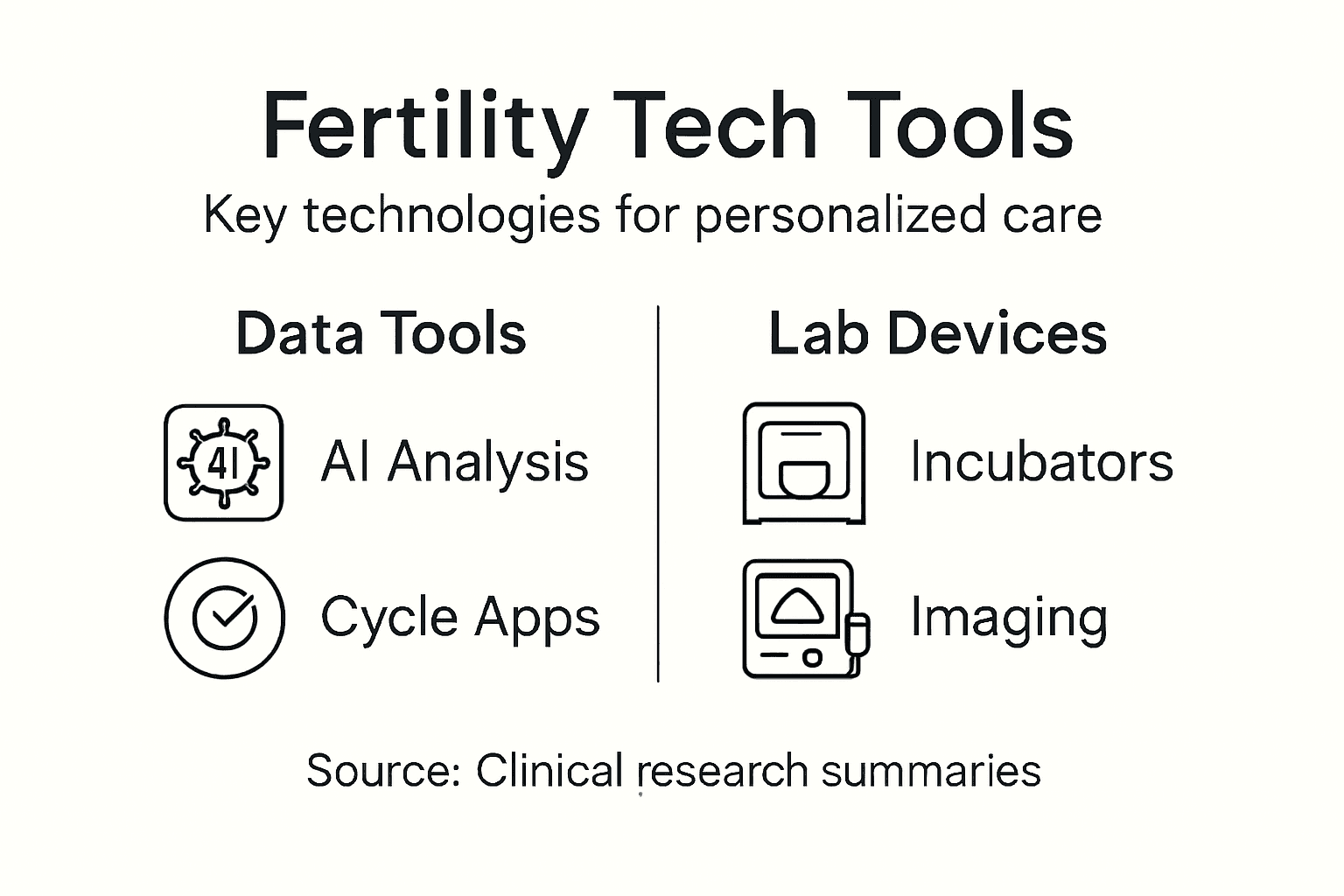
For quick reference, here are the main types of tech tools used in fertility care and their primary uses:
Technology Category | Core Function | Typical User Benefit |
Tracking Applications | Monitor cycles, predict ovulation | Better timing, actionable insights |
Wearable Devices | Measure hormones, body signals | Continuous health information |
Genetic Screening Platforms | Assess genetic risks | Early risk identification |
AI Imaging Systems | Examine reproductive structures | Improved diagnostics, faster results |
This summary table helps clarify how each tech tool supports distinct steps in the reproductive journey.
Pro tip: Research and compare multiple tech tools, focusing on their data privacy policies, accuracy rates, and integration capabilities with professional medical systems.
How AI Streamlines Embryo Selection and Scoring
Advanced AI technologies00517-4/fulltext) are transforming embryo selection by introducing unprecedented precision and objectivity into the complex process of identifying the most viable embryos for successful implantation. This technological breakthrough represents a significant leap forward in reproductive medicine, replacing traditional subjective assessment methods with data-driven, comprehensive evaluation strategies.
The AI-driven embryo selection process involves multiple sophisticated techniques:
Morphological analysis using high-resolution microscopic imaging
Genetic risk scoring based on comprehensive chromosomal assessments
Predictive machine learning algorithms for implantation potential
Dynamic time-lapse monitoring of embryo development
Multiparameter computational evaluation integrating clinical and visual data
Traditional embryo selection relied heavily on manual visual inspection, which introduced significant human bias and variability. Artificial intelligence now enables a more objective approach by analyzing hundreds of subtle morphological and developmental characteristics that might escape human perception.

Here’s a comparison of traditional versus AI-enhanced fertility treatment approaches:
Approach | Evaluation Method | Success Rate Impact | Personalization Level |
Traditional | Manual visual assessment | Moderate, varies by clinic | Limited, based on standard care |
AI-Enhanced | Data-driven, algorithmic | Up to 30% higher | Highly personalized, adaptive |
This table highlights how AI is shifting fertility care toward more accurate and individualized strategies.
AI embryo selection technologies can increase successful implantation rates by up to 30% compared to traditional manual assessment methods.
The computational models leverage vast datasets, learning from thousands of previous fertility cases to generate increasingly accurate predictive scores. This approach not only improves selection accuracy but also provides clinicians with detailed insights into each embryo’s potential for successful development and implantation.
Pro tip: Request a detailed explanation of your clinic’s specific AI embryo scoring methodology to understand how technology is enhancing your personal fertility journey.
Financial, Ethical, and Safety Implications
Global fertility technology research reveals complex challenges surrounding the integration of advanced reproductive technologies into healthcare systems. The intersection of financial accessibility, ethical considerations, and patient safety represents a critical frontier in modern fertility care, demanding nuanced approaches that balance technological innovation with fundamental human rights.
Key considerations in the ethical landscape of fertility technologies include:
Cost transparency in reproductive treatments
Patient consent protocols for emerging technologies
Data privacy protection in AI-driven fertility platforms
Equitable access to advanced reproductive solutions
Comprehensive risk assessment for technological interventions
The financial implications of fertility technologies are particularly significant. Advanced reproductive treatments often represent substantial out-of-pocket expenses for patients, with complex insurance coverage landscapes that can create significant barriers to access. Many individuals face challenging financial decisions when pursuing fertility treatments, weighing potential success rates against considerable monetary investments.
Ethical AI implementation requires balanced approaches that prioritize patient autonomy, data protection, and transparent decision-making processes.
Safety considerations extend beyond immediate medical interventions, encompassing long-term genetic, psychological, and technological risks. Regulatory frameworks must continuously evolve to address emerging technological capabilities, ensuring that patient protection remains paramount in an increasingly complex reproductive technology ecosystem.
Pro tip: Request comprehensive documentation about your clinic’s ethical guidelines, safety protocols, and financial transparency before committing to any advanced fertility treatment.
Patient-Centric Benefits and Common Pitfalls
Fertility tracking technologies empower patients by providing unprecedented insights into reproductive health, while simultaneously presenting nuanced challenges that require careful navigation. This technological landscape offers remarkable opportunities for personalized care, balanced with potential risks that demand informed patient engagement.
Key patient-centric benefits of advanced fertility technologies include:
Personalized reproductive health insights
Enhanced treatment precision
Transparent decision-making tools
Reduced emotional uncertainty
Faster diagnostic processes
Comprehensive genetic risk assessments
The psychological dimensions of fertility technologies are particularly complex. Patient expectations must be carefully managed, recognizing that technological advances, while promising, cannot guarantee absolute reproductive success. Patients navigate a delicate emotional terrain where hope intersects with scientific probability.
Advanced fertility technologies transform patient experiences by shifting from generalized to personalized reproductive healthcare models.
Potential pitfalls in fertility technologies require critical patient awareness. Data privacy concerns, potential algorithmic biases, and the risk of over-relying on technological predictions represent significant challenges. Patients must maintain active engagement, asking critical questions and understanding the limitations of technological interventions.
Pro tip: Develop a balanced perspective by combining technological insights with professional medical guidance, and always maintain open communication with your healthcare providers.
Experience Personalized and Faster Fertility Care with Advanced Technology
The article highlights the challenges many face today navigating complex fertility treatments that lack personalization and depend too much on lengthy, costly procedures. At Aurea Fertility, we understand the emotional and financial toll caused by traditional methods and technological uncertainties like AI embryo scoring and genetic screening. Our clinic addresses these pain points by integrating cutting-edge artificial intelligence protocols that not only personalize your care but also dramatically speed up the treatment timeline, often reducing wait times from several months to about two weeks. We combine AI-driven embryo monitoring, male fertility testing, and egg freezing decisions with dedicated human support to make your journey more hopeful and transparent.
If you are seeking a fertility solution focused on precision, reduced costs, and rapid results, discover how Aurea Fertility leverages technology to transform your experience. Learn more about our approach and services at Aurea Fertility. Begin your path to parenthood with confidence by exploring our AI-enhanced treatment options that prioritize your unique needs. Visit Aurea Fertility’s homepage today and take the next step toward personalized, faster care designed for you.
Frequently Asked Questions
What are the main benefits of using AI in fertility treatments?
AI enhances fertility treatments by increasing success rates through improved embryo selection, personalized treatment algorithms, and real-time monitoring. It enables clinicians to analyze vast amounts of genetic and physiological data for more informed decisions.
How does technology improve embryo selection?
Advanced AI technologies significantly improve embryo selection by introducing data-driven assessments of embryo viability, replacing subjective manual evaluations. This approach leads to higher implantation success rates and more personalized care.
What types of technology tools are used in fertility care?
Fertility care technologies include mobile tracking applications for cycle monitoring, wearable devices for hormonal measurements, genetic screening platforms for risk assessment, and AI-powered imaging systems for diagnostics.
What ethical considerations should be addressed with advanced fertility technologies?
Key ethical considerations include cost transparency, patient consent protocols, data privacy protections, equitable access to treatments, and comprehensive risk assessments for technological interventions.
Recommended
Comments