
Future of Embryo Selection: AI’s Impact on Fertility

Choosing the best embryo for IVF no longer relies solely on a trained eye staring through a microscope. For tech-savvy women with good ovarian reserve, the search for smarter, faster fertility care now includes AI-driven embryo selection that outperforms clinical teams and adds measurable accuracy to each decision. This guide reveals how artificial intelligence brings consistency, objectivity, and cost-saving potential to every step of your journey toward pregnancy.
Table of Contents
Key Takeaways
Point | Details |
Embryo Selection Enhanced by AI | AI improves embryo selection accuracy by converting subjective methods into data-driven decisions, thus increasing the chances of successful implantation. |
Personalized Treatment Plans | AI customizes treatment protocols based on individual fertility profiles, improving responsiveness to patient needs. |
Operational Efficiency | AI accelerates the evaluation process, providing faster results and reducing turnaround time for embryo transfers. |
Ethical Considerations | Patients should inquire about potential biases in AI systems, transparency of algorithm workings, and accountability in case of errors. |
Embryo Selection and AI Technology Basics
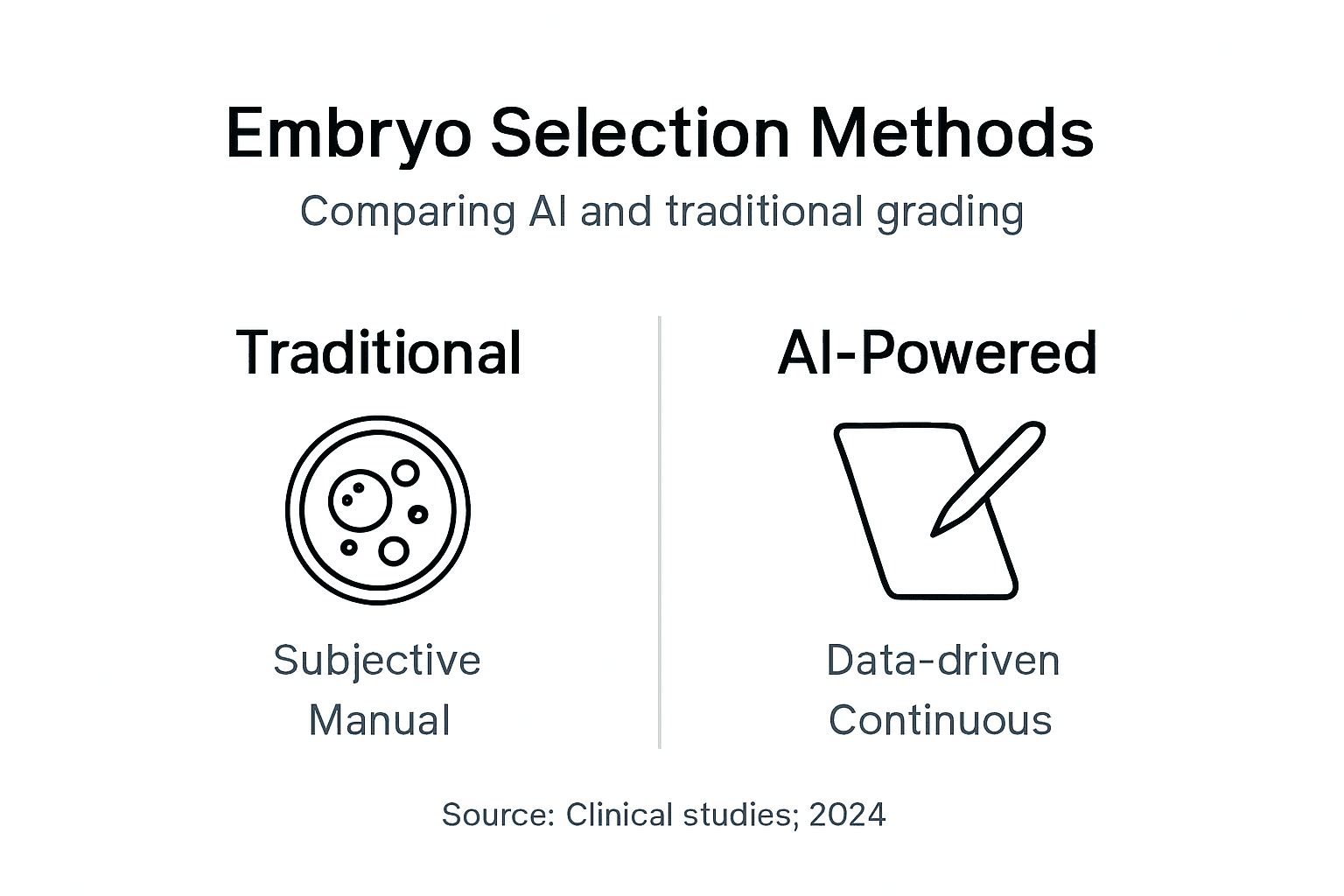
Embryo selection is the process of choosing the healthiest, most viable embryos for transfer during IVF treatment. Historically, embryologists relied on visual inspection under microscopes to assess morphology, development stage, and potential viability. This subjective approach introduced variability between clinics and even between different embryologists evaluating the same embryo.
AI transforms this evaluation from subjective assessment into data-driven decision-making. Machine learning algorithms analyze multiple data sources simultaneously—images, time-lapse videos, and clinical metrics—to predict which embryos have the highest implantation potential.
How AI Evaluates Embryos
AI systems use computer vision to analyze embryo characteristics that human eyes might miss. The technology examines:
Cell symmetry and fragmentation patterns
Blastocyst expansion and collapse timing
Pronuclei movement and disappearance rates
Cell division synchronization
Zona pellucida thickness and appearance
AI-driven embryo assessment consistently outperforms clinical teams in predicting which embryos will develop into healthy pregnancies. The algorithms reduce human bias and create objective, reproducible scores that improve decision-making accuracy.
AI doesn’t replace embryologists—it enhances their judgment by providing quantifiable data that increases confidence in embryo selection decisions.
Unlike human observation, which depends on the embryologist’s experience and attention at a single moment, AI reviews continuous data throughout the embryo’s development. Time-lapse imaging captures every cell division, allowing algorithms to detect patterns invisible to the naked eye.

What Makes AI Different from Traditional Methods
Traditional embryo grading uses a three-letter system (like “AA,” “BB,” “CC”) that categorizes embryos as good, fair, or poor. This binary approach doesn’t capture the full complexity of embryo development potential.
Personalized embryo selection with AI analyzes unlabeled datasets and creates individualized predictions for each patient’s embryos. This non-invasive approach means no additional testing or biopsies—just smarter analysis of what’s already being observed.
Key advantages include:
Reduced subjectivity: Algorithm-based scoring removes personal interpretation
Faster results: AI processes data in hours instead of days
Lower costs: No invasive genetic testing required for initial selection
Better accuracy: Algorithms identify embryo potential with measurable precision
For women under 40 with good ovarian reserve, this means more accurate embryo matching to your biological profile, increasing implantation odds without unnecessary procedures.
Here’s a concise comparison of traditional vs. AI-assisted embryo selection approaches:
Aspect | Traditional Grading | AI-Assisted Selection |
Decision Basis | Subjective visual assessment | Data-driven algorithmic scoring |
Consistency Among Clinics | Varies widely | Standardized across cases |
Speed of Evaluation | Several hours to days | Results within hours |
Personalization Level | Limited by protocols | Matches individual profiles |
Pro tip: Ask your fertility clinic whether they use AI-assisted embryo scoring and how the technology integrates with their grading protocol—this determines whether you’re getting subjective estimates or data-backed predictions.
Modern Techniques and Variations Explained
AI-powered embryo selection isn’t one-size-fits-all. Fertility clinics use different techniques and technological approaches depending on their infrastructure, patient population, and treatment goals. Understanding these variations helps you evaluate which clinic’s methodology aligns with your needs.
Some clinics use AI as a secondary review tool, where algorithms verify embryologist assessments. Others deploy AI as the primary scoring mechanism, with embryologists confirming the algorithm’s recommendations. Both approaches improve accuracy, but they operate on different philosophies.
Time-Lapse Imaging and Continuous Monitoring
Time-lapse technology captures images of embryos every 5-15 minutes throughout development, creating a video record of cell division and morphological changes. This continuous monitoring reveals patterns that static microscope snapshots miss.
AI algorithms analyze time-lapse data to identify:
Timing of cell divisions (blastomere symmetry)
Duration between mitotic events
Fragmentation patterns and resolution
Compaction and blastulation speed
Expansion and re-expansion cycles
Time-lapse systems are expensive, so not all clinics offer them. However, clinics with this technology typically achieve higher embryo selection accuracy because AI has more data to analyze.
Clinics using time-lapse imaging with AI integration report more reliable embryo predictions than those relying on static morphology assessment alone.
Multi-Modal Data Integration
Advanced AI systems combine multiple data sources into one comprehensive evaluation. Rather than analyzing images alone, these systems integrate:
Morphological imaging data
Developmental timing metrics
Patient age and ovarian reserve
Fertilization parameters
Previous cycle outcomes (if applicable)
This holistic approach personalizes predictions to your specific biological profile. An embryo that scores well for one patient might have different viability odds for another patient based on individual factors.
Genetic Testing Integration
Some clinics pair AI embryo selection with preimplantation genetic testing (PGT) for chromosomal abnormalities. AI helps identify which embryos are worth testing, reducing unnecessary testing costs while ensuring high-potential embryos undergo genetic screening.
This combination minimizes:
Unnecessary biopsies on low-viability embryos
Testing delays
Overall treatment expenses
Other clinics use AI selection alone without genetic testing, particularly for younger women with low miscarriage risk.
Speed of Implementation
Different clinics integrate AI differently into their timelines. Some provide AI scores within 24 hours of fertilization, allowing faster decision-making on which embryos to transfer first. Others use AI for retrospective analysis after embryo transfer decisions have been made.
Faster AI integration means shorter overall treatment timelines, which matters if you’re managing work, finances, or emotional energy around fertility treatment.
Pro tip: When evaluating fertility clinics, ask specifically how they use AI in their workflow—whether it’s real-time scoring during your cycle or post-cycle analysis—because this directly impacts how quickly you receive results and move forward with transfer.
How AI Improves Success and Patient Care
AI transforms fertility treatment from a game of chance into a precision-based process. By removing human variability and adding data-driven insights, AI measurably improves outcomes while reducing the emotional and financial toll of repeated failed cycles.
The improvements span three key areas: embryo selection accuracy, treatment personalization, and operational efficiency. Each directly impacts whether your IVF cycle succeeds or fails.
Embryo Selection Precision
AI-driven embryo quality predictions significantly increase transfer success rates by identifying embryos with the highest implantation potential. Algorithms evaluate hundreds of morphological parameters simultaneously, catching subtle development patterns that embryologists might miss during visual assessment.
The result: fewer failed transfers, fewer miscarriages, and faster progression to pregnancy.
Key improvements include:
Higher implantation rates per transfer
Reduced miscarriage risk through better embryo selection
Fewer transfers needed to achieve pregnancy
Lower overall cycle costs due to fewer failed attempts
AI doesn’t guarantee pregnancy, but it dramatically increases the odds that each embryo transferred has the highest possible viability.
Personalized Treatment Protocols
AI analyzes your individual fertility profile—age, ovarian reserve, previous cycle responses, sperm quality, fertilization rates—to customize your treatment plan. Rather than applying standard protocols to everyone, AI identifies which approaches work best for your specific biology.
This personalization reduces:
Unnecessary medication adjustments
Wasted cycle time on ineffective protocols
Adverse responses to medication
Patient stress from misaligned treatment plans
Women under 40 with good ovarian reserve benefit significantly because AI identifies the optimal stimulation approach for your reserves, avoiding both under-stimulation and over-stimulation.
Operational Efficiency and Speed
AI-assisted quality control in IVF labs automates traditionally manual embryo and sperm evaluation tasks, reducing human error while accelerating timelines. What once took days now takes hours. What once depended on a single embryologist’s assessment now has algorithmic verification.
Faster results mean:
Quicker embryo transfer decisions
Reduced specimen handling time
More consistent evaluation across all embryos
Earlier pregnancy confirmation
Patient Care Beyond Outcomes
AI reduces psychological burden by providing transparent, quantifiable reasoning for treatment decisions. Instead of hearing “this embryo doesn’t look good,” you receive specific morphological scores explaining why.
This transparency builds confidence and reduces:
Anxiety about embryo selection decisions
Questions about whether clinics are making optimal choices
Emotional distress from subjective evaluations
Decision paralysis when choosing between embryos
Faster treatment cycles also mean less time managing fertility while balancing work, relationships, and finances—critical for your overall well-being.
Pro tip: Request your clinic’s AI-assisted selection data in writing before your cycle—specific morphology scores, algorithm confidence percentages, and comparison metrics—so you can review the reasoning behind which embryos they recommend for transfer.
Ethical, Legal, and Safety Issues
AI in embryo selection raises legitimate concerns that deserve your attention. While the technology improves outcomes, it also introduces questions about fairness, transparency, and who bears responsibility when things go wrong. Understanding these issues helps you make informed decisions about your care.
The main concerns cluster around three areas: algorithmic bias, accountability gaps, and access inequality. Each affects patients differently depending on clinic practices and regulatory oversight.
Algorithmic Bias and Fairness
Algorithmic bias in AI embryo selection occurs when AI models trained on limited datasets reflect those datasets’ limitations. If algorithms are trained primarily on embryos from one age group, ethnic background, or fertility profile, they may perform less accurately for patients outside that demographic.
This creates real consequences:
Some patients receive less accurate predictions than others
AI scores may unfairly disadvantage certain embryo types
Clinics serving diverse populations need different algorithmic validation
Treatment recommendations could inadvertently favor certain patient groups
Fertility clinics should disclose which populations their AI systems have been validated on and acknowledge performance gaps for underrepresented groups.
Bias doesn’t mean AI is intentionally discriminatory—it means the training data may not represent your population equally, affecting prediction accuracy for you.
Transparency and Accountability
Ethical adoption of AI in embryo assessment requires transparent explanation of how algorithms work and who’s responsible when outcomes disappoint. Currently, many clinics use proprietary AI systems that don’t disclose their exact decision-making logic.
Critical transparency gaps include:
How algorithms weight different morphological features
What training data was used to build the model
Accuracy rates for different patient demographics
How confidence thresholds were determined
What happens if AI recommendations conflict with embryologist assessment
Without transparency, you cannot evaluate whether the clinic’s AI system is appropriate for your situation.
The Responsibility Question
Who’s liable if AI makes a poor recommendation that results in an unsuccessful transfer? The clinic? The AI company? The embryologist? Current legal frameworks don’t clearly define this, leaving a responsibility gap that puts patients at risk.
Before choosing a clinic, ask:
Who is responsible if AI recommendations prove incorrect?
Does the clinic have insurance covering AI-assisted decisions?
Can you access the raw AI scores and reasoning?
What’s the clinic’s protocol when AI and embryologist assessments disagree?
Access and Justice
AI-powered embryo selection costs more upfront, potentially widening the gap between patients who can afford advanced technology and those who cannot. This creates an equity problem where better treatment access depends on financial resources.
Despite these concerns, AI adoption continues expanding. Reputable clinics manage ethical risks by being transparent about limitations, validating algorithms across diverse populations, and maintaining human oversight alongside algorithmic recommendations.
Pro tip: Ask your fertility clinic directly: How is your AI system validated? Which populations were in the training data? What happens if AI scores conflict with your embryologist’s assessment? Their answers reveal whether they’ve thoughtfully addressed ethical risks.
The following table summarizes key AI risks and questions to discuss at fertility clinics:
Concern Area | Risk or Challenge | Key Patient Question |
Algorithmic Bias | Poor prediction for some groups | Was the system validated for my profile? |
Transparency | Unclear scoring logic | Can I review raw AI ratings? |
Accountability | Unclear liability for errors | Who is responsible for bad outcomes? |
Cost | Significant added expense | How much extra does AI assessment cost? |
Risks, Costs, and What to Avoid
AI embryo selection isn’t risk-free, and it’s expensive. Before committing to a clinic using AI technology, understand what can go wrong, how much it costs, and which marketing claims deserve skepticism.
The biggest risk isn’t AI itself—it’s overhyping AI capabilities without solid clinical evidence. Some clinics market AI as a guaranteed path to pregnancy when the reality is more nuanced.
The Evidence Gap
AI-assisted embryo selection shows comparable pregnancy rates to traditional methods in randomized controlled trials, but does not yet demonstrate clear superiority. This matters because clinics often charge premium prices based on the assumption that AI dramatically improves outcomes.
What this means:
AI may help, but current evidence doesn’t prove it beats conventional embryo assessment
Some AI systems are better validated than others
Clinical benefits vary based on patient age, embryo quality, and other factors
Impressive marketing claims often outpace actual scientific evidence
Don’t assume higher cost equals better outcomes. Ask clinics for published data supporting their AI system’s effectiveness, not just internal success rates.
Current evidence shows AI improves consistency and reduces bias, but doesn’t guarantee better pregnancy rates than experienced embryologists using traditional methods.
Cost Realities
AI embryo assessment adds $1,500 to $5,000 per cycle, depending on the technology and clinic. For women cycling multiple times, these costs accumulate quickly.
Key cost factors:
Time-lapse incubation systems (required for some AI tools)
Proprietary AI software licensing fees
Staff training and certification
Data analysis and reporting infrastructure
Some clinics bundle AI costs into overall cycle pricing. Others charge separately. Always request a detailed breakdown before committing.
Technical Risks to Watch
Algorithmic errors and dataset bias pose real technical risks when AI systems haven’t been thoroughly validated. An AI model trained on embryos from one clinic may perform poorly for your population or embryo quality profile.
Risks include:
AI scores reflecting biases in training data
Algorithms failing for unusual embryo presentations
System errors causing misclassification
Poor generalization across different patient demographics
Before choosing AI-assisted selection, ask whether the clinic’s system has been independently validated and how it performs for patients like you.
Red Flags to Avoid
Skip clinics that:
Claim AI guarantees pregnancy or dramatically higher success rates
Won’t disclose their AI system’s accuracy rates by patient demographic
Charge premium prices without published evidence supporting their AI
Don’t maintain embryologist oversight alongside AI recommendations
Can’t explain their AI’s decision-making process
Haven’t validated their system on diverse patient populations
Legitimate clinics acknowledge AI’s benefits and limitations transparently.
Pro tip: Request any published studies about your clinic’s specific AI system before your cycle, and ask whether you can see your individual embryo scores with written explanations of what each score means.
Experience the Future of Fertility with AI-Powered Embryo Selection
The article highlights the challenge of subjective embryo grading and the uncertainties involved in traditional embryo selection methods. With concerns like algorithmic bias, unclear decision processes, and costly procedures, patients need a trusted solution that delivers personalized, data-driven insights. At Aurea Fertility, we understand these pain points and put AI-assisted embryo scoring and monitoring at the core of our practice to reduce guesswork and accelerate your journey to parenthood.
Our approach combines continuous time-lapse imaging and comprehensive AI analysis tailored to your unique biological profile. This means faster, more objective embryo evaluations with high precision to increase implantation success rates while minimizing emotional stress and financial waste. We support you every step of the way with 24/7 personalized communication so you feel confident and informed.
Discover how our cutting-edge methods transform fertility treatment by visiting Aurea Fertility. Learn more about how we integrate AI for embryo monitoring and scoring on our main landing page. Take control of your fertility journey today and join the many women and couples under 40 who are benefiting from faster, more effective care. Start now to reduce delays and get the personalized treatment you deserve with Aurea Fertility.
Frequently Asked Questions
What is AI in embryo selection, and how does it work?
AI in embryo selection utilizes advanced machine learning algorithms to analyze various data sources—such as images and time-lapse videos of embryos—to predict their viability for implantation, enhancing the decision-making process for embryologists.
How does AI improve embryo selection accuracy compared to traditional methods?
AI improves embryo selection by providing objective, data-driven assessments that reduce human bias and increase the reliability of scoring, resulting in higher implantation rates and fewer miscarriages.
What are the benefits of using AI for embryo selection during IVF?
The benefits of using AI for embryo selection include reduced subjectivity in assessments, faster results, and improved personalization of treatment plans, which can lead to higher success rates in achieving pregnancy.
Are there any risks associated with using AI for embryo selection?
Yes, there are risks, including potential algorithmic bias if the training data is limited, accountability gaps regarding responsibility for recommendations, and the high costs associated with AI technologies in fertility treatments.
Recommended


Comments