
Fertility Care Efficiency: Transforming Outcomes With AI
- 3 days ago
- 12 min read

Sorting through endless fertility tests and unclear protocols can leave you feeling stuck before your journey even begins. For women under 40 with strong ovarian reserve, the real challenge is getting care that values your time, health, and emotional well-being. The World Health Organization now recognizes infertility as a global public health priority, emphasizing the demand for efficient, evidence-based fertility care that removes barriers and tailors every step to your unique profile.
Table of Contents
Key Takeaways
Point | Details |
Efficiency in Fertility Care | Focus on personalized treatment pathways that eliminate unnecessary tests and streamline processes to improve outcomes. |
AI Integration | AI-driven approaches enhance diagnostic accuracy, treatment personalization, and speed of care, improving success rates and reducing costs. |
Financial Impact | Utilizing data-driven practices lowers treatment costs and emotional burdens while increasing the likelihood of successful pregnancies. |
Choosing Clinics | Look for clinics that prioritize data transparency, real-time communication, and evidence-based protocols to ensure quality care. |
Fertility Care Efficiency Defined and Debunked
Fertility care efficiency means getting you the right treatment at the right time without unnecessary delays or procedures. This isn’t about rushing through your care—it’s about removing friction, cutting out redundant tests, and personalizing your pathway based on what your body actually needs.
The World Health Organization recently released its first global guideline on infertility, establishing infertility as a major public health priority. This shift matters because it legitimizes the need for efficient, equitable care that works for everyone, not just wealthy patients who can afford months of testing.
Here’s what efficiency actually looks like in fertility care:
No redundant screening. You’re not retested for conditions already confirmed in your medical history.
Data-driven decisions. Every recommendation stems from your specific metrics, not generic protocols.
Compressed timelines. Quality diagnostics and treatment planning happen in weeks, not months.
Transparent communication. You know exactly why each step matters and what to expect next.
The Myths Holding Fertility Care Back
One major misconception: more tests equal better outcomes. This isn’t true. Excessive testing increases costs, delays treatment, and creates psychological burden without improving success rates. Understanding why fertility treatments fail reveals that inefficiency often stems from outdated protocols, not insufficient data.
Another myth: efficiency means cutting corners. Wrong. Efficiency means eliminating waste while preserving precision. AI-driven embryo monitoring catches details human eyes miss, reducing guesswork while keeping you informed throughout your cycle.
Many patients assume affordable care sacrifices quality. The reality: streamlined processes reduce overhead costs, passing savings directly to you without compromising clinical outcomes. Fertility treatment costs significantly impact access, making efficiency a matter of equity, not just convenience.
What Actually Drives Efficiency
Three core factors separate efficient fertility care from traditional approaches:
Predictive analytics identify your specific challenges before they become problems.
Automation of routine tasks frees clinicians to focus on complex decision-making.
Real-time monitoring systems catch changes immediately, enabling rapid protocol adjustments.
Efficiency also means your clinic respects your time. No waiting weeks between consultations. No unclear results. No redundant appointments.
True efficiency in fertility care means achieving better outcomes faster while reducing emotional and financial burden—without cutting corners on clinical precision.
Pro tip: When evaluating a fertility clinic, ask specifically what tests they’ll skip based on your profile and why. Clinics that eliminate unnecessary procedures while maintaining safety standards are prioritizing genuine efficiency over revenue maximization.
AI-Driven Fertility Treatments Explained
AI-driven fertility treatments represent a fundamental shift in how clinicians diagnose problems, select embryos, and predict your chances of success. Instead of relying on visual assessments and standard protocols, AI analyzes thousands of data points from your cycle to create a treatment plan tailored specifically to you.
Here’s what happens behind the scenes. Artificial intelligence transforms IVF by processing complex reproductive data that human observation alone would miss. The system learns from millions of previous cycles, identifying patterns that correlate with healthy pregnancies and successful outcomes.
How AI Actually Works in Your Cycle
AI-driven fertility care operates across three critical stages:
Diagnostic phase. AI analyzes your bloodwork, imaging, and medical history to pinpoint exact reproductive challenges without unnecessary testing.
Treatment personalization. Algorithms adjust medication protocols, timing, and retrieval procedures based on your real-time response metrics.
Embryo assessment. Machine learning evaluates embryo morphology, genetics, and viability markers that correlate with implantation success.
Each decision point uses data, not guesswork. If your hormone levels indicate a particular response pattern, your protocol shifts accordingly. If an embryo shows specific developmental characteristics, scoring reflects actual predictive value.
Embryo Selection and Grading
Traditional embryo grading relies on microscopic observation at specific timepoints. AI changes this by continuously monitoring development through time-lapse imaging, capturing hundreds of frames that reveal growth patterns invisible to the human eye.

AI-driven solutions analyze complex datasets to predict which embryos have the highest implantation potential. The system doesn’t just look at the final product—it tracks how the embryo developed, identifying rhythms and timing that correlate with viability.
This matters because standard morphology scoring misses critical information. An embryo can look identical to another under the microscope but have fundamentally different developmental trajectories. AI catches these distinctions.
Treatment Personalization at Speed
One of AI’s biggest advantages: it compresses decision cycles. Traditional clinics might wait days between consultations to review results and adjust protocols. AI systems provide real-time recommendations, allowing your clinic to optimize your care within hours instead of days.
This speed directly improves outcomes. When hormone response data arrives, your dosage adjusts immediately. When follicle measurements indicate readiness, your trigger shot timing aligns perfectly with your biology. No delays. No guessing.
AI-driven fertility care means your treatment responds to your body in real time, not to population averages or clinician intuition.
Personalization also means fewer side effects. If your system predicts ovarian hyperstimulation syndrome based on your response pattern, protocols prevent it before it happens. If your hormone sensitivity differs from typical ranges, medication adjusts preemptively.
Pro tip: Ask your fertility clinic specifically how they use AI in embryo assessment and whether they employ continuous time-lapse monitoring. Clinics that combine AI scoring with real-time imaging data provide the most accurate embryo viability predictions.
Personalized Protocols and Embryo Scoring
Personalized protocols mean your fertility treatment adapts to your body in real time, not to a one-size-fits-all template. Your clinic monitors your specific hormone response, follicle development, and egg quality throughout your cycle, adjusting medication doses and timing as data arrives.
Traditional clinics use standard stimulation protocols based on broad categories: normal responder, poor responder, high responder. Your actual biology might fall between these categories or shift unexpectedly. AI-driven personalization catches these nuances before they become problems.
How Personalized Protocols Work
Your customized protocol considers multiple factors from day one:
Baseline ovarian reserve assessment. Your age, AMH levels, and antral follicle count inform initial medication selection.
Real-time hormone monitoring. Daily blood draws track estrogen, progesterone, and LH patterns specific to your cycle.
Ultrasound response tracking. Follicle sizes and growth rates trigger protocol adjustments within hours, not days.
Medication titration. Doses increase, decrease, or stay constant based on your individual response curve.
This responsiveness prevents both under-stimulation and over-stimulation. You retrieve the maximum number of quality eggs without unnecessary risk or discomfort.
Embryo Scoring Beyond Morphology
Traditional embryo grading (grades like 2AA or 4BC) reflects what an embryologist sees through a microscope at a single moment. Embryo monitoring for IVF success now incorporates continuous developmental tracking, revealing patterns invisible in static images.
AI-driven scoring evaluates multiple dimensions simultaneously:
Morphology. Cell symmetry, fragmentation, and appearance remain important.
Developmental timing. When the embryo reaches each stage matters significantly.
Metabolic markers. Nutrient consumption and waste production indicate cellular health.
Genetic indicators. Aneuploidy prediction based on morphokinetic patterns.
The result: embryos receive scores that predict actual implantation probability, not just visual appearance. An embryo that looks average but develops with optimal timing might score higher than a visually perfect embryo with irregular progression.
Speed Without Sacrifice
Personalized protocols compress your treatment timeline dramatically. Instead of waiting a week between appointments to review results and adjust strategy, your clinic makes protocol changes within 24 hours of new data.
This acceleration directly improves outcomes. Your egg retrieval timing aligns precisely with ovulation readiness. Your embryo transfer occurs at the optimal developmental window. Your implantation window matches your uterine receptivity.
Personalized protocols mean your treatment follows your biology’s timeline, not a calendar schedule.
Cost efficiency improves too. By eliminating unnecessary medication and preventing over-stimulation, you reduce total drug expenditure while increasing success probability per cycle.
Pro tip: Before starting treatment, ask your clinic how they use continuous monitoring to adjust your protocol and what criteria determine embryo selection. Clinics that explain both the reasoning and the data behind decisions are prioritizing true personalization.
Financial, Emotional, and Success Impacts
Fertility treatment traditionally depletes savings, strains relationships, and delivers unpredictable outcomes. Women under 40 with good ovarian reserve often face months of treatment at premium costs with no guarantee of success. AI-driven efficiency changes this equation across three critical dimensions: cost, emotional burden, and success probability.
The Financial Reality of Traditional Care
Conventional fertility clinics operate on extended timelines. A typical cycle stretches 3-6 months from initial consultation to pregnancy test, sometimes longer. During this period, you pay for multiple office visits, redundant testing, expensive medications, and procedures that might not directly improve your outcome.
Financial burden infertility care places on individuals often leads to catastrophic household expenditures, forcing families to deplete savings, take loans, or abandon treatment entirely. This affects not just wealthy patients—it creates healthcare inequity that excludes those without substantial financial resources.
AI-driven efficiency compresses costs by eliminating waste:
Fewer unnecessary tests. You skip screening redundant with your history.
Optimized medication dosing. Personalized protocols prevent over-medication and associated costs.
Compressed timelines. Two-week treatment cycles versus three-month cycles mean lower cumulative expenses.
Higher success per cycle. Better embryo selection increases pregnancy probability, reducing total cycles needed.
The math works dramatically in your favor. A woman needing three traditional cycles at 15,000 dollars each faces 45,000 dollars total. The same patient with AI-driven care might achieve pregnancy in two cycles at 18,000 dollars combined—saving 27,000 dollars while improving her odds.
Here’s a comparison of traditional vs. AI-driven fertility care approaches:
Aspect | Traditional Fertility Care | AI-Driven Fertility Care |
Treatment Timeline | 3-6 months per cycle | 2 weeks per cycle |
Protocol Approach | Generic categories used | Fully personalized protocols |
Embryo Selection | Visual, manual grading | AI-powered predictive scoring |
Cost Efficiency | Higher due to redundancy | Lower via optimized processes |
Success Rates | Lower, more cycles needed | Higher, fewer cycles needed |
Emotional Impact | High stress, more uncertainty | Reduced anxiety, faster answers |
Psychological and Emotional Impacts
Fertility treatment’s emotional toll equals its financial burden. Extended timelines create prolonged hope and disappointment cycles. Uncertainty about protocol decisions increases anxiety. Failed cycles compound psychological distress, especially when you question whether your clinic optimized your care.
AI-driven efficiency alleviates this burden multiple ways:
Clarity and transparency. Data-driven recommendations eliminate guesswork about treatment choices.
Faster results. Two-week cycles mean quicker answers instead of months of uncertainty.
Reduced failed cycles. Better embryo selection decreases negative outcomes.
Continuous support. Real-time communication through WhatsApp or similar tools means answers arrive immediately, not after waiting for clinic hours.
Efficient fertility care reduces not just financial burden, but psychological stress—allowing you to preserve mental health while pursuing parenthood.
Women report significantly lower anxiety when they understand their protocol, see real-time data, and receive rapid responses to concerns. This psychological benefit matters as much as clinical outcomes.
Success Rate Improvements
Success probability improves measurably with AI integration. Better embryo selection increases implantation rates. Personalized protocols reduce cycle cancellations. Optimized timing improves egg quality and uterine receptivity.
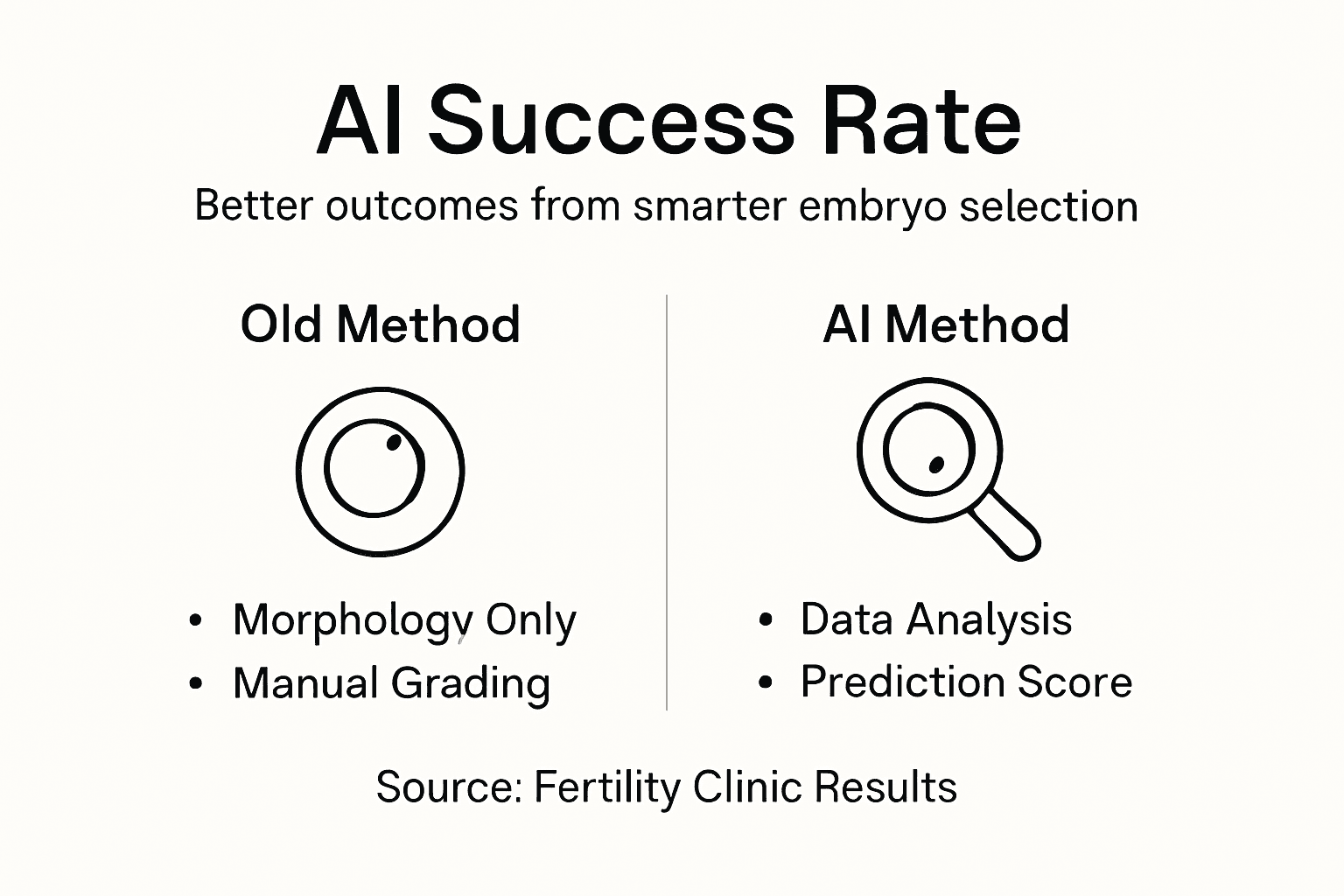
Clinics using AI-driven approaches report higher success rates per cycle, meaning you achieve pregnancy faster and more reliably. For women under 40 with good ovarian reserve, success rates can increase by 15-25 percent compared to standard protocols.
These improvements compound economically. Higher success probability means fewer cycles needed, directly reducing total treatment costs while improving your emotional outcome and timeline to parenthood.
Pro tip: Request your clinic’s success rates for your specific age and ovarian reserve profile, both with and without AI-assisted embryo selection. Compare these transparently against national averages to understand your true probability of success before committing financially.
Common Pitfalls and Choosing Efficient Clinics
Not all fertility clinics operate with genuine efficiency. Some market speed without delivering it. Others implement AI superficially while maintaining outdated protocols. Distinguishing between truly efficient clinics and those merely claiming innovation requires understanding what pitfalls to avoid.
The Biggest Clinic Pitfalls
Inefficient clinics share recognizable patterns. One major problem: variability in standardized protocols. Different clinics use wildly different approaches to identical patient profiles, suggesting clinical decisions depend on clinician preference rather than evidence-based data.
Another dangerous pitfall involves unproven add-ons. Clinics often recommend expensive supplemental treatments—special culture media, immune testing, genetic screening panels—without solid evidence they improve outcomes for your situation. Overuse of add-ons without proven benefits significantly inflates treatment costs without improving success rates.
A third pitfall: lack of transparency. Efficient clinics publish their success rates by age group and diagnosis. Clinics hesitant to share specific outcome data likely have something to hide.
Red Flags When Evaluating Clinics
Before committing financially and emotionally, assess these warning signs:
Vague success rate reporting. Claims like “good outcomes” without specific percentages indicate poor transparency.
No discussion of your specific protocol. Generic treatment plans reveal clinics aren’t personalizing care.
Extended appointment scheduling. If consultations book weeks out or results take days to receive, efficiency isn’t a priority.
Aggressive add-on selling. Pressure to purchase unproven treatments suggests revenue-focused rather than outcome-focused practice.
No AI or data integration. Even mentioning embryo monitoring software, real-time dashboards, or predictive analytics indicates commitment to modern methods.
What Efficient Clinics Actually Look Like
Efficient clinics prioritize data-driven decision-making and transparent outcomes reporting. Here’s what to expect:
Published success rates broken down by age, AMH, and diagnosis.
Clear protocol explanations showing why your treatment differs from standardized approaches.
Real-time communication through portals, WhatsApp, or apps—not waiting for office hours.
AI-enhanced embryo assessment with time-lapse monitoring and morphokinetic analysis.
Compressed treatment timelines measured in weeks, not months.
Transparent fee structures with no hidden add-on costs.
Patient outcome tracking showing their specific success rates over time.
When evaluating clinics, request their most recent success rate data, ask how they personalize protocols, and observe how quickly they respond to questions. Speed of response often correlates with operational efficiency.
Choosing an efficient clinic isn’t about finding the most prestigious name—it’s about finding one that measures outcomes rigorously and optimizes treatment based on your data.
Pro tip: Contact three clinics with similar questions about your specific profile, then compare response time, explanation depth, and specific success rate data they provide. The clinic that delivers detailed answers fastest, with published outcomes and clear personalization logic, prioritizes efficiency over marketing.
Below is a quick reference of red flags and positive traits when evaluating fertility clinics:
Clinic Trait | Red Flag Sign | Positive Indicator |
Success Rate Reporting | Vague or missing data | Published, age-specific rates |
Personalization | Generic protocols applied | Individualized treatment plans |
Communication Speed | Long response delays | Real-time updates available |
Add-On Treatments | Aggressive upselling | Evidence-backed options only |
Technology Use | Lacks AI/data tools | AI and analytics integrated |
Fee Structure | Hidden or complex costs | Transparent, detailed pricing |
Experience True Efficiency in Fertility Care with Aurea Fertility
The challenges highlighted in “Fertility Care Efficiency: Transforming Outcomes With AI” reveal how traditional fertility treatments often involve lengthy timelines, redundant testing, and unclear communication. If you are seeking faster, personalized treatment that minimizes emotional and financial stress, Aurea Fertility offers a groundbreaking solution. Our AI-driven protocols ensure you receive tailored care based on your unique reproductive profile, avoiding unnecessary tests while boosting your chances of success.
Explore how our advanced embryo monitoring and real-time hormonal tracking shorten treatment cycles from months to just weeks. With transparent data-driven decisions and 24/7 support through WhatsApp, we put you in control of your journey. Discover a fertility clinic committed to maximizing outcomes without cutting corners. Visit Aurea Fertility today to learn more about our efficient, technology-powered solutions and start your path toward parenthood with confidence.
Ready to transform your fertility experience and benefit from personalized AI care? Connect with us now at Aurea Fertility and embrace faster, smarter fertility treatment designed around you.
Frequently Asked Questions
What is fertility care efficiency?
Fertility care efficiency refers to receiving the right treatment at the right time, minimizing unnecessary tests and delays. It focuses on personalizing treatment pathways to meet individual needs without cutting corners on clinical precision.
How does AI improve fertility treatments?
AI enhances fertility treatments by analyzing complex reproductive data to provide tailored diagnostic assessments, optimize medication protocols, and improve embryo selection processes—resulting in faster, more effective care with higher success rates.
What are the benefits of personalized protocols in fertility care?
Personalized protocols adapt treatment based on real-time data about a patient’s hormone response and follicle development. This responsiveness prevents both under- and over-stimulation, maximizing the number of quality eggs retrieved while minimizing risks.
Why is transparency important in choosing a fertility clinic?
Transparency indicates a clinic’s commitment to evidence-based practices. Efficient clinics provide clear success rates, detailed explanations of personalized protocols, and proactive communication, helping patients make informed decisions about their treatment choices.
Recommended
Comments