
Modern Fertility Clinic Technology: AI’s Impact on Fertility
- Feb 12
- 7 min read

Finding reliable fertility care can feel overwhelming, especially when balancing fast-paced lifestyles and emotional health priorities. As AI-driven clinics reshape reproductive medicine worldwide, tech-savvy women are discovering personalized solutions that promise quicker results and greater peace of mind. This article uncovers how advanced diagnostic tools and AI-powered analysis are transforming modern fertility treatment, offering affordable options and holistic support for urban women seeking rapid, effective outcomes.
Table of Contents
Key Takeaways
Point | Details |
Advancements in Technology | Modern fertility clinics utilize advanced diagnostics and AI-driven tools to enhance treatment effectiveness. |
Personalized Care | Personalized treatment plans are developed through predictive analytics, improving patient outcomes and satisfaction. |
Understanding Costs | Patients should grasp the financial implications of treatments, including success rate variables and comprehensive cost breakdowns. |
Ethical Considerations | Awareness of AI ethics, data privacy, and potential biases is essential for patients navigating fertility technologies. |
Defining Modern Fertility Clinic Technology
Modern fertility clinic technology represents a revolutionary intersection of medical science and artificial intelligence, transforming reproductive healthcare through advanced diagnostic and treatment approaches. These technologies go far beyond traditional methods, incorporating sophisticated tools that enhance precision, personalization, and success rates for individuals seeking fertility solutions.
The core of modern fertility technology involves multiple interconnected technological domains:
Advanced Diagnostic Tools: High-resolution imaging and genetic screening techniques
AI-Powered Analysis: Machine learning algorithms for embryo selection and prediction
Genomic Screening: Comprehensive genetic testing for potential inherited conditions
Precision Treatment Protocols: Customized interventions based on individual genetic profiles
Reproductive technologies are rapidly evolving, potentially transforming conception and pregnancy practices through innovations like in vitro gametogenesis and genome engineering. These cutting-edge approaches extend beyond traditional assisted reproductive technologies, offering unprecedented opportunities for individuals struggling with fertility challenges.
The technological landscape encompasses several sophisticated methodologies, including:
Intracytoplasmic sperm injection
Preimplantation genetic testing
Mitochondrial replacement therapy
Laser-assisted embryo procedures
Time-lapse embryo monitoring
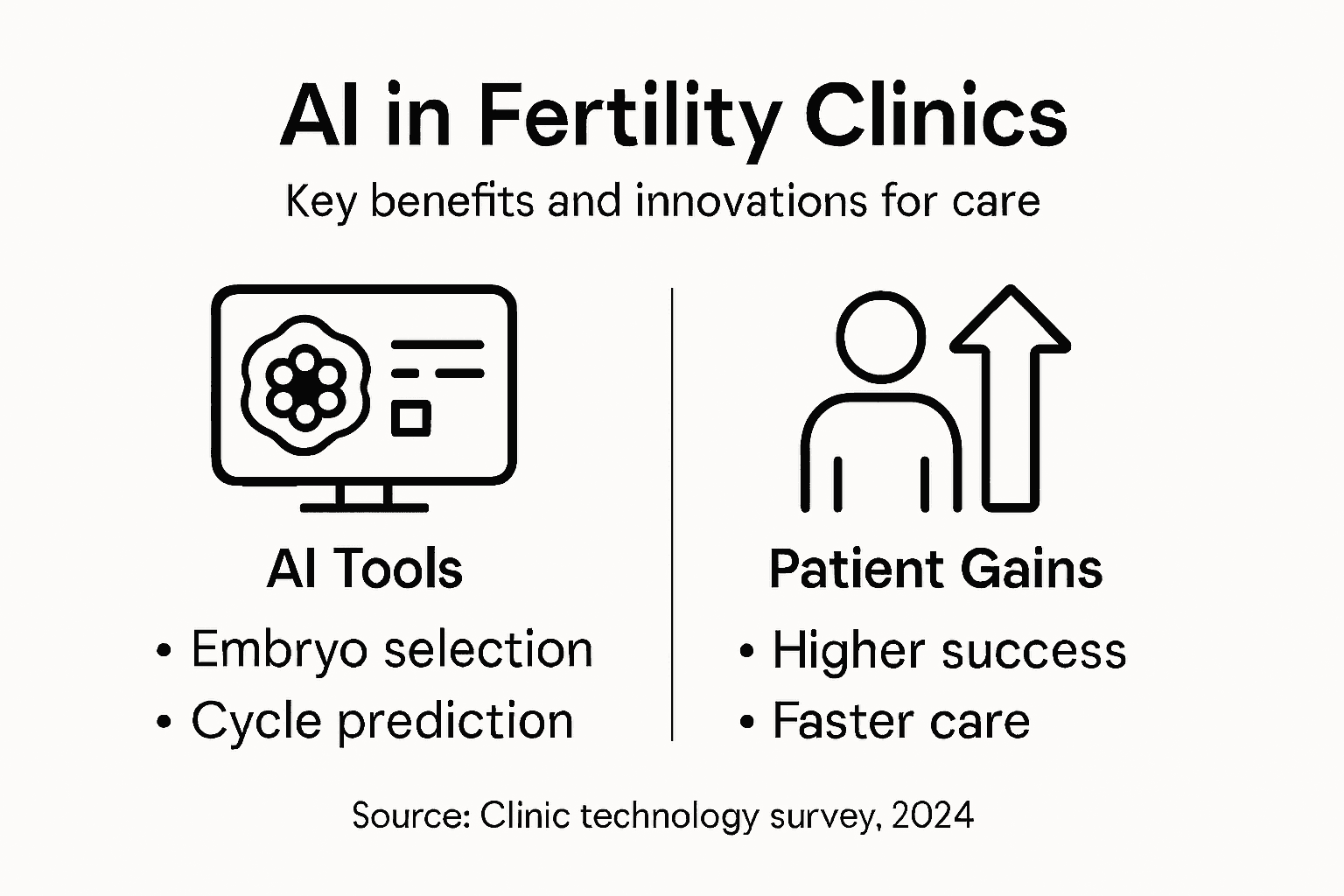
Artificial intelligence is particularly transformative, optimizing critical aspects of fertility treatments by enabling more accurate embryo selection, refining clinical protocols, and improving outcome predictions. By analyzing complex datasets with unprecedented speed and accuracy, AI helps clinicians make more informed decisions.

Here’s how leading fertility clinic technologies compare in terms of function and clinical impact:
Technology Type | Primary Function | Clinical Benefit |
High-resolution Imaging | Visualizes reproductive structures | Improved diagnostic accuracy |
AI Embryo Selection | Analyzes embryo viability | Increased pregnancy rates |
Genomic Screening | Detects genetic abnormalities | Reduced inherited condition risks |
Automated Sperm Analysis | Evaluates sperm quality | Faster, objective assessments |
Personalized Protocol Modeling | Customizes treatment plans | Higher treatment effectiveness |
Pro tip: When exploring fertility technologies, always request comprehensive genetic screening and ask about AI-assisted diagnostic processes to maximize your treatment potential.
Key Innovations: AI and Automation Tools
Artificial intelligence is revolutionizing fertility clinics through sophisticated automation tools that dramatically enhance treatment precision and efficiency. AI-powered neural networks and machine learning algorithms are transforming traditional reproductive medicine by introducing unprecedented levels of accuracy and personalization in fertility treatments.
Key innovations in AI and automation tools include:
Embryo Selection Algorithms: Advanced machine learning models that analyze embryo imagery
Predictive Analytics: Systems predicting treatment success rates with high accuracy
Automated Genetic Screening: AI-driven comprehensive genetic condition assessments
Real-time Embryo Monitoring: Continuous tracking and evaluation of embryo development
These technological advancements represent a significant shift in reproductive healthcare. Deep learning technologies are now capable of outperforming human embryologists in critical tasks like embryo selection, offering more objective and consistent evaluations based on complex dataset analyses.
The automation landscape in fertility clinics now encompasses multiple sophisticated approaches:
Convolutional neural network image analysis
Predictive clinical outcome modeling
Automated sperm quality assessment
Personalized treatment protocol optimization
Standardized embryo grading systems
By leveraging these advanced technologies, fertility clinics can reduce human error, minimize subjective assessments, and provide more precise, data-driven treatment recommendations. The integration of AI ensures a more streamlined, efficient, and personalized approach to reproductive healthcare.
Pro tip: When consulting fertility specialists, inquire specifically about their AI-assisted diagnostic and selection processes to understand the technological sophistication of their treatment protocols.
Personalized Care With Rapid Treatment Pathways
Modern fertility clinics are revolutionizing patient experiences through innovative, technology-driven approaches that dramatically reduce treatment timelines and enhance personalized care. AI-driven patient-centric treatment strategies now bridge medical interventions with comprehensive emotional support, creating holistic fertility solutions that address both physiological and psychological needs.
Key components of personalized rapid treatment pathways include:
Predictive Risk Assessment: Advanced algorithms analyzing individual patient profiles
Emotional Support Integration: Cognitive-behavioral therapy alongside medical treatments
Rapid Diagnostic Protocols: Streamlined genetic and health screenings
Individualized Treatment Planning: Customized intervention strategies based on precise data
The integration of machine learning technologies has transformed traditional fertility treatment models. Patient-centric prognostic tools now provide unprecedented insights, enabling fertility specialists to offer more accurate success probability predictions and tailored treatment recommendations.
These innovative approaches offer multiple advantages for patients:
Reduced overall treatment time
Higher precision in diagnostic processes
More accurate success rate predictions
Comprehensive emotional and medical support
Minimized unnecessary medical interventions
By combining advanced technological capabilities with personalized patient care, modern fertility clinics are creating more efficient, compassionate, and effective treatment experiences that significantly improve patients’ chances of successful reproductive outcomes.
Pro tip: Request a comprehensive consultation that includes both AI-driven diagnostic insights and personalized emotional support planning to maximize your fertility treatment potential.
Success Rates, Costs, and What to Expect
Navigating fertility treatments requires understanding realistic success rates and potential financial investments. AI-enhanced reproductive technologies are transforming patient expectations by improving clinical outcomes and potentially reducing overall treatment costs through advanced predictive capabilities.
Key metrics patients should understand include:
Success Rate Variables: Age, genetic factors, and treatment protocols
Cost Considerations: Treatment complexity and technological interventions
Predictive Accuracy: Advanced AI-driven outcome forecasting
Financial Planning: Comprehensive treatment cost estimates
Currently, European fertility data reveals significant challenges in assisted reproductive technologies. Embryo selection models are now developing sophisticated approaches to increase live birth rates, which traditionally hover around one-third of treatment cycles.
Patients can expect the following treatment landscape dynamics:
More precise embryo selection processes
Reduced number of multiple pregnancy risks
Shorter time-to-pregnancy trajectories
More transparent cost structures
Higher potential success probabilities
By leveraging advanced AI technologies, fertility clinics are creating more predictable, personalized treatment pathways that offer patients clearer insights into their reproductive potential and financial commitments.
Here’s a summary of success factors and cost considerations for fertility treatments:
Key Factor | Why It Matters | Patient Benefit |
Age | Major influence on treatment outcome | Informed expectations |
Genetic Profile | Impacts embryo selection decisions | Customized care strategies |
AI Predictive Models | Forecasts individual success chances | Greater peace of mind |
Transparent Pricing | Clarifies all expected costs | Improved financial planning |
Treatment Protocol | Determines overall complexity | Optimized clinical workflow |
Pro tip: Request a comprehensive consultation that includes AI-generated success probability models and transparent cost breakdowns to make informed fertility treatment decisions.
Risks, Safety, and Common Misconceptions
Addressing risks and safety concerns is crucial in modern fertility treatments, especially with the rapid integration of artificial intelligence technologies. International best practices for AI validation emphasize patient safety, clinical excellence, and ethical implementation as fundamental principles in reproductive medicine.
Common misconceptions about AI in fertility treatments include:
Algorithmic Bias: Potential for unintended discriminatory outcomes
Data Privacy Concerns: Risks of personal information exposure
Over-reliance on Technology: Diminishing human clinical judgment
Unrealistic Success Expectations: Misunderstanding predictive probabilities
The ethical landscape of reproductive technologies involves complex challenges. Socio-ethical complexities in AI deployment highlight potential risks of reinforcing social inequalities and creating unintended stratifications in reproductive healthcare.
Patients should be aware of key safety considerations:
Verify clinic’s AI validation protocols
Understand algorithmic decision-making processes
Request transparency in treatment recommendations
Confirm data privacy and protection measures
Maintain open communication with medical professionals
Responsible AI integration requires careful governance, continuous ethical evaluation, and a commitment to patient-centered care that prioritizes individual needs and equitable access to reproductive technologies.
Pro tip: Always ask fertility clinics about their specific AI ethics protocols, data protection measures, and how they mitigate potential algorithmic biases in treatment recommendations.
Harness the Power of AI for Faster, Personalized Fertility Care
Struggling with the complexities and emotional stress of fertility treatments is common. Modern fertility clinic technology, including AI-powered embryo selection and predictive analytics, offers hope by improving success rates and reducing treatment timelines. At Aurea Fertility, we understand that personalized care and rapid treatment pathways matter deeply, especially when every day counts. Our AI-driven protocols bring advanced genetic screening, embryo monitoring, and male fertility testing into one streamlined process designed to minimize unnecessary tests and maximize your chances of success.
Experience fertility care where state-of-the-art technology meets compassionate, patient-centered support. Benefit from our 24/7 communication tools and transparent treatment plans that prioritize both effectiveness and affordability. Discover how cutting-edge AI innovations can transform your fertility journey at Aurea Fertility. Ready to take the next step in your path to parenthood Explore our approach to rapid, personalized fertility treatment and start your consultation today at Aurea Fertility. Empower yourself with the future of reproductive care.
Frequently Asked Questions
What is the role of AI in modern fertility clinic technology?
AI enhances fertility treatments by optimizing embryo selection, predicting treatment success rates, and personalizing care based on individual patient data.
How does advanced diagnostic technology improve fertility treatments?
Advanced diagnostic tools, including high-resolution imaging and genomic screening, provide more accurate assessments of reproductive health, leading to improved treatment efficacy and success rates.
What are personalized rapid treatment pathways in fertility clinics?
Personalized rapid treatment pathways utilize AI-driven strategies to streamline diagnostic processes and create individualized treatment plans, significantly reducing overall treatment time and enhancing patient care.
What should I ask my fertility specialist about AI technology in their clinic?
Inquire about the clinic’s AI-assisted diagnostic processes, embryo selection methods, data privacy measures, and how they address potential algorithmic biases in treatment recommendations.
Recommended
Comments