
Egg Freezing Explained: Fast, Affordable Options

Setting aside worries about the ticking biological clock, many women in cities around the world are searching for ways to protect their future fertility while focusing on career and personal goals. Egg freezing is not just for older women or those facing medical challenges—success is actually higher when eggs are collected at a younger age, according to research from the Human Fertilisation and Embryology Authority. AI-driven technologies now deliver tailored fertility insights, giving you the power to make confident, informed reproductive choices.
Table of Contents
Key Takeaways
Point | Details |
Egg Freezing Process | Understanding the steps—ovarian stimulation, egg retrieval, freezing, and storage—is essential for effective fertility preservation. |
Myth Busting | Many misconceptions about egg freezing exist; it’s beneficial for women under 35 and modern techniques maintain egg viability. |
Personalized Approach | Consulting with fertility specialists and utilizing AI can optimize fertility outcomes and tailor egg freezing strategies. |
Financial Considerations | The procedure involves significant costs, and insurance coverage can vary, making thorough financial planning crucial. |
Egg freezing basics and common myths
Egg freezing represents a groundbreaking fertility preservation technique that empowers women to take control of their reproductive choices. Modern fertility preservation allows women to store healthy eggs for future use, protecting their biological timeline against age-related fertility decline.
Understanding the core process involves knowing several key steps:
Ovarian Stimulation: Hormonal medications trigger multiple egg production
Egg Retrieval: Mature eggs are carefully extracted during a minor surgical procedure
Egg Freezing: Eggs are rapidly cooled using vitrification, a flash-freezing technique
Storage: Eggs are securely preserved in liquid nitrogen at extremely low temperatures
Numerous myths surround egg freezing that discourage women from exploring this powerful option. The most common misconceptions include:
Myth: Egg freezing is only for women over 35
Reality: Peak fertility and egg quality occur between ages 25-32, making this an ideal time
Myth: Frozen eggs are less viable than fresh eggs
Reality: Modern vitrification techniques maintain near-equivalent egg quality
Myth: The procedure is extremely risky or painful
Reality: Most women experience minimal discomfort with proper medical supervision
The success of egg freezing significantly increases when eggs are collected at a younger age, highlighting the importance of proactive fertility planning.
Pro tip: Schedule a comprehensive fertility assessment before 35 to understand your unique reproductive potential and explore personalized egg freezing strategies.
Types and purposes of egg freezing procedures
Egg freezing has evolved into a sophisticated fertility preservation strategy with distinct purposes and approaches. Oocyte cryopreservation offers women two primary pathways: medical and elective egg freezing, each serving unique reproductive goals.
The two primary types of egg freezing include:
Medical Egg Freezing (MEF): - Designed for women facing potential fertility loss due to medical treatments
Common scenarios include cancer therapy, autoimmune disorders, or surgical interventions
Often partially or fully covered by medical insurance
Elective Egg Freezing (EEF):
Chosen by healthy women to extend reproductive timeline
Typically selected by professionals delaying childbearing
Provides reproductive autonomy and flexibility
The motivations behind egg freezing are diverse and deeply personal. Fertility preservation strategies reveal that women choose this procedure for various compelling reasons:

Here’s a clear comparison of medical vs. elective egg freezing:
Aspect | Medical Egg Freezing | Elective Egg Freezing |
Primary Purpose | Prevent fertility loss | Delay childbearing |
Target Group | Women with medical risks | Healthy women |
Insurance Coverage | Often partially covered | Rarely fully covered |
Decision Drivers | Urgent medical necessity | Personal or lifestyle goals |
Career development and professional advancement
Waiting to find the right partner
Financial stability and personal readiness
Managing age-related fertility decline
Medical precautions against potential future fertility challenges
Egg freezing represents a powerful intersection of medical technology and personal reproductive choice, offering women unprecedented control over their fertility journey.
Pro tip: Consult a reproductive specialist early to understand your specific fertility profile and determine the most appropriate egg freezing approach for your unique circumstances.
How AI improves egg freezing success rates
Artificial intelligence is transforming egg freezing from a traditional medical procedure into a precision-driven reproductive technology. AI technologies are revolutionizing egg analysis by providing unprecedented insights into egg quality and potential fertility outcomes.
Key ways AI enhances egg freezing include:
Advanced Image Analysis:
Non-invasive microscopic image evaluation
Precise assessment of individual egg viability
Machine learning algorithms detect subtle quality indicators
Predictive Fertility Modeling:
Calculates live birth probabilities with greater accuracy
Considers multiple complex genetic and cellular factors
Provides personalized probability estimates beyond traditional age-based metrics
The most significant AI innovations in egg freezing focus on three critical areas:
Egg Quality Assessment
Analyzing cellular morphology and structural integrity
Predicting potential embryo development chances
Identifying high-potential eggs with superior genetic profiles
Treatment Optimization
Recommending personalized stimulation protocols
Determining optimal freezing and thawing techniques
Minimizing unnecessary medical interventions
Outcome Prediction
Generating realistic expectation models
Supporting more informed patient decision-making
Reducing emotional and financial uncertainty
AI transforms egg freezing from a standardized procedure into a deeply personalized reproductive strategy, offering women unprecedented insights into their fertility potential.
Pro tip: Request comprehensive AI-assisted fertility assessment to understand your unique reproductive landscape and potential success probabilities.
Step-by-step egg freezing process and requirements
Egg freezing is a sophisticated medical procedure designed to preserve fertility with multiple carefully orchestrated stages. Egg freezing involves a comprehensive process that requires medical expertise, patient commitment, and precise clinical protocols.
The initial stages of egg freezing include:
Pre-Procedure Consultation:
Comprehensive medical history review
Fertility assessment and diagnostic testing
Personalized treatment plan development
Medical Screening:
Hormone level evaluation
Genetic screening
Infectious disease testing
Ovarian reserve assessment
The complete egg freezing journey follows these primary steps:
Initial Consultation and Screening
Detailed medical history discussion
Comprehensive fertility diagnostic tests
Personalized treatment strategy development
Ovarian Stimulation
Hormone injections administered over 8-12 days
Regular ultrasound monitoring
Blood tests to track hormone levels
Stimulation aims to produce multiple mature eggs
Egg Retrieval
Performed under sedation
Transvaginal ultrasound-guided needle extraction
Collection of mature eggs from ovaries
Egg Freezing and Storage
Rapid vitrification technique
Eggs preserved in liquid nitrogen
Secure long-term storage
Successful egg freezing requires a personalized approach that considers individual reproductive health, age, and specific fertility goals.
Pro tip: Consult multiple fertility specialists and request comprehensive genetic screening to maximize your egg freezing success potential.
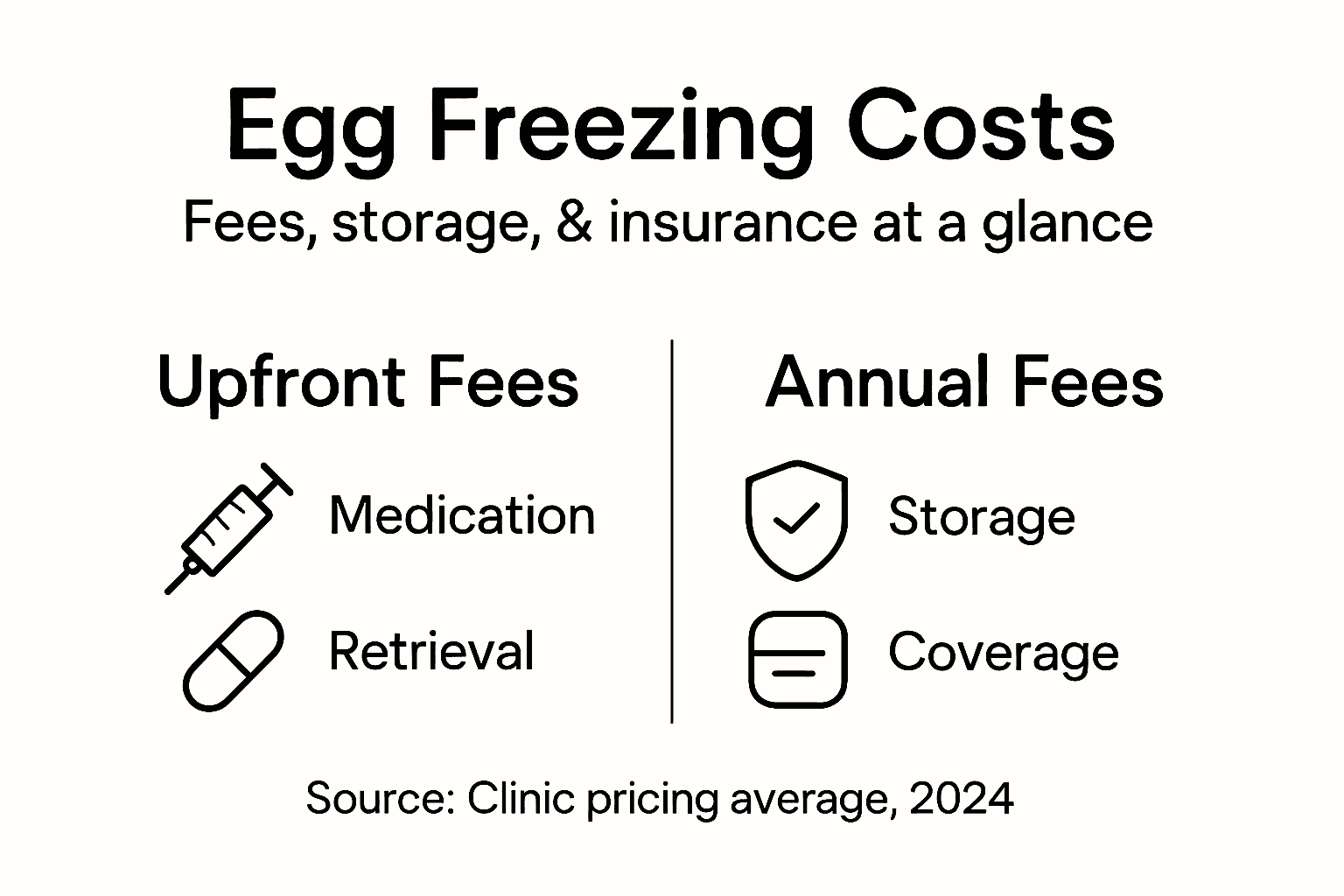
Costs, storage fees, and insurance coverage
Egg freezing represents a significant financial investment with multiple cost components that potential patients must carefully consider. Insurance coverage for egg freezing varies widely, requiring thorough research and strategic financial planning.
Typical cost breakdown for egg freezing includes:
Initial Procedure Costs:
Medical consultation fees
Diagnostic testing
Hormone medications
Ultrasound monitoring
Egg retrieval procedure
Storage and Maintenance Expenses:
Annual storage fees
Liquid nitrogen preservation
Periodic egg quality assessments
Long-term maintenance charges
Financial considerations for egg freezing can be categorized into several key areas:
Explore typical costs and coverage options for egg freezing procedures:
Expense Category | Price Range | Coverage Possibilities |
Initial Medical Fees | $200-$10,000 | Sometimes reimbursed by insurance |
Storage Charges | $300-$1,000/year | Rarely covered, mostly out-of-pocket |
Medication Costs | $2,500-$5,000 | May be partly reimbursed |
Upfront Medical Expenses
Initial consultation: $200-$500
Diagnostic testing: $1,000-$3,000
Hormone medications: $2,500-$5,000
Egg retrieval procedure: $5,000-$10,000
Ongoing Storage Costs
Annual storage fees: $300-$1,000
Long-term preservation charges
Potential periodic assessment costs
Insurance and Coverage Options
Employer-sponsored fertility benefits
Partial medical coverage
Flexible spending accounts
Healthcare savings options
Most insurance plans do not fully cover elective egg freezing, making out-of-pocket expenses a critical consideration for patients.
Pro tip: Consult your HR department about potential fertility preservation benefits and explore financing options before committing to the procedure.
Risks, limitations, and key safety issues
Egg freezing, while a groundbreaking fertility preservation technique, involves complex medical considerations that patients must thoroughly understand. Egg freezing carries specific medical risks that require careful evaluation and informed consent.
Medical risks associated with the procedure include:
Ovarian Stimulation Risks:
Ovarian hyperstimulation syndrome (OHSS)
Hormonal fluctuations
Potential temporary discomfort
Procedural Risks:
Minor surgical complications
Potential infection
Rare bleeding incidents
The key safety limitations can be categorized into several critical areas:
Medical Risks
OHSS affecting less than 2.5% of cycles
Severe OHSS occurring in 0.1-2% of cases
Infection risk below 0.5%
Biological Limitations
Not all frozen eggs survive thawing
Success rates vary by age and egg quality
Uncertain long-term effects on potential offspring
Ethical Considerations
Potential false expectations
Access and equity concerns
Commercialization of fertility preservation
Responsible medical practice requires comprehensive disclosure of potential risks, uncertain outcomes, and individual variability in egg freezing success.
Pro tip: Request a detailed risk assessment from your reproductive specialist, including clinic-specific success rates and potential complications specific to your health profile.
Take Control of Your Fertility Journey Today
Egg freezing offers women a powerful way to preserve fertility but navigating the process can feel overwhelming due to cost, timing, and medical risks. This article highlights the need for personalized, fast, and affordable solutions that combine cutting-edge technology with compassionate care. If you want to avoid prolonged treatment times and unnecessary procedures while maximizing your chances with AI-driven egg quality assessment and streamlined protocols this is your moment.
At Aurea Fertility, we specialize in AI-enhanced egg freezing treatments designed to minimize discomfort and cost while boosting success rates. Our rapid treatment pathways cut down typical timelines from months to as few as two weeks allowing you to act swiftly on your reproductive goals. We provide clear guidance, cost-effective options, and 24/7 support, empowering women under 40 with good ovarian reserve to make confident, informed choices.
Discover how our AI-driven fertility assessments and personalized egg freezing programs can simplify your journey. Why wait and risk age-related fertility decline when you can start with expert care and innovative technology today? Visit Aurea Fertility now to learn more and take the first step toward securing your fertility future.
Frequently Asked Questions
What is the egg freezing process?
The egg freezing process involves several key steps: ovarian stimulation with hormonal medications, egg retrieval through a minor surgical procedure, and freezing the eggs using vitrification, followed by long-term storage in liquid nitrogen.
How does egg freezing work for different purposes?
Egg freezing can be done for medical reasons, such as preserving fertility before undergoing cancer treatments, or electively, allowing healthy women to delay childbearing for personal or professional reasons.
Are frozen eggs as viable as fresh eggs?
Yes, modern vitrification techniques ensure that frozen eggs maintain high viability, often comparable to fresh eggs. This allows women greater flexibility in planning their families.
What are the typical costs associated with egg freezing?
The costs of egg freezing can vary significantly, typically ranging from $200 to $10,000 for the initial procedure, plus annual storage fees ranging from $300 to $1,000. Insurance coverage may vary, so it’s essential to check with your provider.
Recommended


Comments