
Fertility Assessment: Fast, Personalized AI Solutions

Trying for a baby can feel like solving a puzzle when the answers are unclear and advice seems conflicting. Many women under 40 with good ovarian reserve find themselves lost in a maze of fertility myths while searching for fast, affordable solutions. Fertility assessment is your gateway to real answers, revealing what helps or hinders your path to pregnancy without unnecessary delays or invasive steps. Discover how AI-driven evaluations replace guesswork and make your fertility journey clearer and more focused from the start.
Table of Contents
Key Takeaways
Point | Details |
Fertility Assessment Importance | A fertility assessment provides crucial insights into reproductive health and identifies specific factors impacting conception. Personalized evaluations are essential for effective treatment planning. |
Myth Busting | Many misconceptions about fertility, such as the impact of age on egg quality and the necessity of extensive testing, can delay necessary evaluations. Understanding facts about fertility can prompt timely assessments. |
AI-Driven Improvements | AI technology significantly enhances fertility assessments by allowing for continuous monitoring and personalized analysis, leading to quicker and more accurate results compared to traditional methods. |
Cost Considerations | Traditional fertility assessments can be expensive, often ranging from $3,000 to $5,000. AI-informed assessments help reduce costs by focusing on essential tests tailored to individual needs. |
Defining Fertility Assessment and Common Myths
Fertility assessment is the comprehensive diagnostic process that evaluates your reproductive health and identifies what might be preventing pregnancy. According to the American Society for Reproductive Medicine, infertility is defined as the inability to achieve pregnancy after 12 months of regular unprotected intercourse, though this timeline adjusts based on your age and specific circumstances. But here’s what matters most: this definition isn’t just clinical terminology. It’s the framework that determines whether you need evaluation, what tests make sense for you, and how urgently you should pursue answers. The goal of fertility assessment goes beyond simply running every test available. Instead, a proper evaluation identifies the specific factors affecting your fertility, whether that involves egg quality, hormone levels, reproductive anatomy, or male factor considerations.
The myths surrounding fertility assessment run surprisingly deep, and they often delay women from getting the answers they need. One pervasive misconception is that fertility is unpredictable and impossible to measure accurately—this simply isn’t true. Modern reproductive medicine has moved far beyond guesswork. Common fertility myths often include false beliefs about hormonal birth control permanently damaging fertility, the assumption that age doesn’t significantly impact egg quality until your late 40s, and the notion that fertility problems are always obvious or symptomatic. Another harmful myth is that extensive testing is always necessary before pursuing treatment. The reality is more nuanced: personalized assessment means determining which tests actually matter for your specific situation, eliminating unnecessary procedures while ensuring nothing important gets missed. This targeted approach is particularly valuable for women under 40 with good ovarian reserve, where a strategic, AI-informed assessment can identify the exact factors that matter for your conception.
Why does proper fertility assessment matter right now? Because the difference between a generic approach and a personalized one directly impacts both your timeline and your outcomes. A fertility assessment reveals baseline reproductive health metrics—ovarian reserve through hormone testing and ultrasound, egg quality indicators, ovulation status, and partner factors if applicable. Rather than assuming you know what’s preventing pregnancy, assessment gives you data. For women focused on rapid, efficient pathways to conception, this diagnostic clarity becomes your foundation. Instead of spending months on treatments that might not address your specific barriers, you understand exactly what needs attention. That knowledge transforms everything about your fertility journey, allowing you to make confident decisions aligned with your priorities and timeline.
Pro tip: Request an assessment that includes both baseline hormone panels (AMH, FSH) and pelvic ultrasound imaging if you haven’t had one recently, since these two diagnostic tools provide complementary information about your ovarian reserve and reproductive anatomy in just one or two clinic visits.
Key Steps in Modern Fertility Testing
Modern fertility testing follows a logical sequence designed to identify barriers to conception without unnecessary delays or excessive procedures. The process begins with what might seem basic but is absolutely foundational: a detailed reproductive history and physical examination. Your clinician asks about menstrual patterns, past pregnancies, contraceptive use, medical conditions, and family history. This conversation shapes everything that follows. Then comes the physical exam, which evaluates your reproductive anatomy and overall health status. These initial steps cost nothing, take minimal time, and often reveal critical information that guides all subsequent testing. From there, the assessment moves into objective measurements through blood work and imaging.
Hormone testing forms the backbone of fertility assessment because hormones directly control ovulation and egg development. The key tests include AMH (anti-Müllerian hormone) to evaluate ovarian reserve, FSH (follicle-stimulating hormone) taken on cycle day 3, and thyroid function tests since thyroid disorders frequently impact fertility. Progesterone testing on cycle day 21 confirms whether ovulation occurred. Many clinics now use modern hormone assessment methods to create a complete picture of your endocrine environment. Ultrasound imaging follows naturally from hormone testing. A transvaginal ultrasound shows your ovaries and uterus, revealing ovarian follicle count, uterine structure, and any abnormalities like fibroids or polyps. For women under 40 with good ovarian reserve, these three components, hormone testing, ovulation tracking, and imaging, often provide sufficient diagnostic clarity without pursuing invasive procedures.

When initial testing suggests possible barriers, additional assessments might follow. Infertility evaluation procedures may include semen analysis if male factor needs assessment, hysterosalpingography (HSG) to evaluate fallopian tube patency, or specialized imaging for specific conditions. The critical shift in modern fertility medicine is this: testing becomes strategic rather than automatic. You’re not running every possible test. Instead, your assessment targets the specific factors most likely to affect your fertility. This personalized approach reduces both cost and timeline significantly. AI-informed assessment accelerates this process further by predicting which test results matter most for your individual situation, allowing clinics to prioritize diagnostic clarity while minimizing time spent on low-yield investigations.
Pro tip: Time your initial hormone blood work for cycle day 2 or 3 to capture accurate baseline FSH levels, and request all results in writing so you can track your own fertility metrics rather than relying solely on clinical interpretation.
AI-Driven Approaches Versus Traditional Methods
Traditional fertility assessment relies on a clinical framework that has remained largely unchanged for decades: blood tests at specific cycle days, ultrasound imaging, and manual record-keeping. These methods work, but they operate within significant limitations. A clinician orders hormone tests on day 3 of your cycle, you return for ultrasound between days 8 and 10, and results are interpreted based on population averages rather than your individual patterns. The timing is rigid. The interpretation is standardized. Your actual reproductive behavior, ovulation patterns, and hormonal responses are reduced to a handful of data points captured on specific calendar dates. Traditional approaches also demand substantial time investment. Multiple clinic visits, waiting for results, scheduling follow-up appointments, and the months-long process of diagnosis before treatment begins is the reality for most women pursuing fertility assessment through conventional channels.
AI-driven approaches fundamentally change this equation by enabling continuous, personalized monitoring instead of snapshot assessments. Artificial intelligence enhances predictive accuracy for ovulation timing and reproductive health outcomes by analyzing patterns across thousands of data points rather than isolated test results. Machine learning algorithms identify your unique hormonal signatures, ovulation patterns, and fertility windows with precision that traditional methods cannot match. Instead of assuming your cycle follows the textbook 28-day pattern, AI learns your actual cycle. Instead of relying on a single FSH measurement, algorithms evaluate how your hormones change across multiple timepoints, revealing your true reproductive status. This personalization matters enormously for women under 40 with good ovarian reserve, where subtle variations in hormone response or ovulation timing can significantly impact conception chances.
The speed advantage is equally dramatic. Traditional assessment stretches across weeks or months. AI-informed fertility evaluation compresses this timeline substantially by prioritizing the specific tests that matter for your situation and eliminating unnecessary procedures. Advanced fertility monitoring tools integrate biological markers like basal body temperature and cervical mucus patterns with algorithmic analysis, creating far more accurate fertility tracking than manual charting ever achieved. You capture data passively through simple apps or wearables rather than requiring multiple clinic visits. Results generate predictions in real time rather than after waiting days for lab processing. For women focused on rapid pathways to conception, this acceleration translates directly into reduced emotional stress and faster access to treatment when assessment identifies barriers requiring intervention. The comparison is stark: traditional methods measure your fertility sporadically and late, while AI-driven approaches anticipate and track fertility continuously and prospectively.
Pro tip: If you choose AI-informed assessment, request access to your complete data dashboard so you can see the actual patterns algorithms are identifying rather than receiving only final clinical interpretations.
Here’s a concise comparison of traditional and AI-driven fertility assessment methods:
Aspect | Traditional Methods | AI-Driven Methods |
Timeline | Weeks to months | Days to weeks |
Personalization | Population averages | Individualized analysis |
Data Collection | Single time points | Continuous monitoring |
Clinic Visits | Multiple required | Fewer, often remote |
Cost Efficiency | May include unnecessary tests | Prioritizes high-value tests only |
Understanding Female and Male Fertility Factors
Fertility is never a solo endeavor. It depends on multiple biological systems working in concert, and assessment requires understanding both partners’ reproductive health. Female fertility centers on a few critical components: ovarian reserve, which reflects the quantity and quality of eggs available; menstrual cycle regularity, which indicates whether ovulation occurs predictably; and reproductive tract health, including patent fallopian tubes and a receptive uterus. Ovarian reserve naturally declines with age, but the rate of decline varies dramatically between individuals. A woman at 35 might have excellent reserve while another at the same age has significantly diminished capacity. This is why assessment focuses so heavily on measuring ovarian reserve through AMH levels and follicle counts rather than relying on age alone. Beyond ovulation and egg quality, female fertility factors include uterine and tubal health that directly influence whether a fertilized egg can implant and develop. Conditions like endometriosis, fibroids, or fallopian tube blockages create mechanical barriers to conception despite otherwise healthy eggs and ovulation.
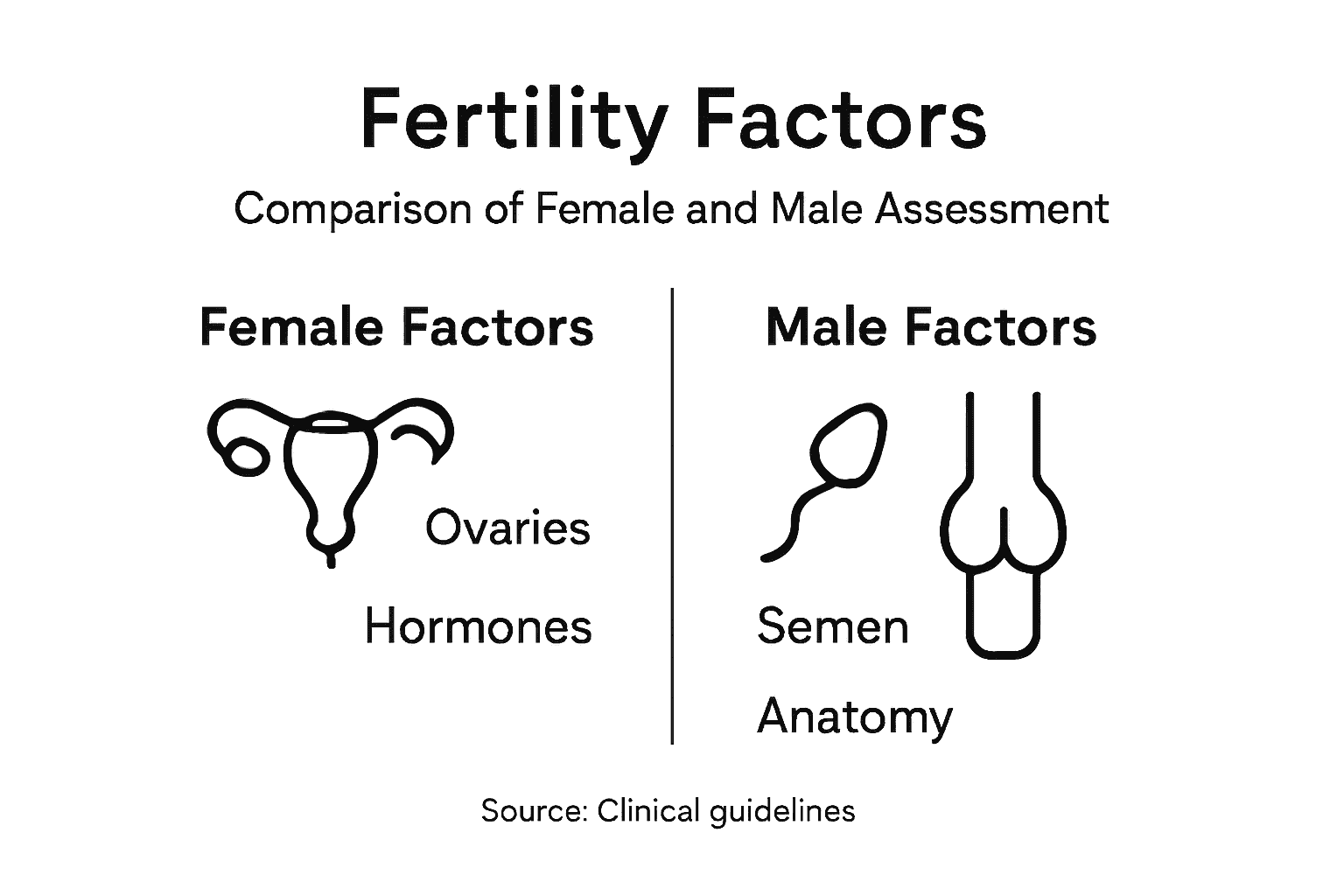
Male fertility assessment examines three primary dimensions: semen quality, hormonal status, and reproductive anatomy. Semen analysis measures sperm count, motility, and morphology, revealing whether sperm can reach and fertilize an egg. Low sperm count or poor motility can dramatically reduce conception odds, yet many men remain unaware of their semen parameters until assessment occurs. Hormonal evaluation in men assesses testosterone and FSH levels, which drive sperm production. Low testosterone or abnormal FSH patterns indicate testicular dysfunction that directly impacts fertility potential. Reproductive anatomy assessment checks for physical abnormalities like varicocele (enlarged veins in the scrotum) that impair sperm production. The critical insight here is that male factor infertility accounts for a significant portion of conception difficulties in couples, yet male assessment is often overlooked or delayed. Many couples focus exclusively on female factors, missing opportunities to address male contributions that could accelerate conception.
Beyond individual biological factors, lifestyle and environmental exposures influence both partners’ fertility significantly. Stress, poor sleep, smoking, excessive alcohol consumption, and obesity all depress fertility outcomes in both men and women. For women, conditions like PCOS and thyroid disorders create hormonal imbalances that disrupt ovulation. For men, heat exposure, certain medications, and occupational hazards can impair sperm production. Assessment that ignores these modifiable factors misses opportunities for improvement. AI-informed assessment accelerates diagnosis by simultaneously evaluating female factors, male factors, and lifestyle contributions rather than assessing them sequentially over months. Instead of months spent investigating female factors before partner evaluation, comprehensive assessment captures the complete fertility picture within weeks, enabling faster identification of barriers and rapid movement toward solutions.
Pro tip: Include your partner in fertility assessment from the start, even if cycles appear regular and obvious female factors seem absent, since male factor assessment is quick, affordable, and often reveals unexpected contributors to conception difficulty.
Below is a summary of key male vs. female fertility assessment factors:
Category | Female Factors Assessed | Male Factors Assessed |
Primary Focus | Ovarian reserve, ovulation, uterus/tubes | Semen quality, hormones, anatomy |
Common Tests | AMH, FSH, ultrasound, HSG | Semen analysis, testosterone, FSH |
Typical Barriers | Low egg count, tubal blockage, endometriosis | Low sperm count, motility issues, varicocele |
Overlooked Contributors | Lifestyle, thyroid, autoimmune conditions | Heat exposure, medication, lifestyle |
Risks, Limitations, and Cost Considerations
Fertility assessment, while valuable, carries both practical limitations and real costs that deserve honest discussion. The most significant limitation is that diagnostic tests cannot predict conception with certainty. A test showing good ovarian reserve does not guarantee pregnancy will occur. Normal semen analysis does not promise successful fertilization. Even when assessment identifies no obvious barriers, conception may still take longer than expected. This unpredictability reflects the fundamental complexity of human reproduction. Assessment reveals your fertility status and identifies major obstacles, but it operates within real constraints. Some conditions remain difficult to diagnose through standard testing. Egg quality, for instance, cannot be measured directly from blood work or ultrasound. Recurrent implantation failure often lacks clear explanation despite thorough investigation. Limitations in diagnostic accuracy mean that comprehensive assessment sometimes yields incomplete answers, requiring couples to make treatment decisions based on partial information rather than definitive diagnoses.
Psychological and physical risks accompany fertility assessment as well, though most are manageable. Blood draws carry minimal risk beyond brief discomfort and rare bruising. Transvaginal ultrasound is noninvasive but can feel uncomfortable or emotionally triggering for some women. More invasive diagnostic procedures like hysterosalpingography or laparoscopy carry small risks of infection or perforation, though serious complications remain rare. The larger psychological burden comes from the assessment process itself. Waiting for results generates anxiety. Learning about fertility barriers can trigger grief or disappointment. Repeated testing over months creates emotional fatigue. These psychological costs are real and often underestimated by healthcare providers focused purely on physical risks.
Cost represents the most immediate practical barrier for many women. Traditional comprehensive fertility assessment can cost $3,000 to $5,000 or more in the United States, with many components not covered by insurance. International pricing varies dramatically, from $500 to $3,000 depending on location and healthcare system. This financial burden creates real disparities in access, meaning women with fewer resources often delay assessment or receive incomplete evaluation. AI-informed assessment addresses this limitation directly by eliminating unnecessary testing. Rather than ordering every possible diagnostic test regardless of clinical relevance, AI-optimized assessment prioritizes tests with highest diagnostic value for your specific situation. This targeted approach reduces both cost and timeline substantially. You spend less money because you’re not paying for low-yield investigations. You spend less time because rapid, personalized diagnosis enables faster movement toward treatment decisions. For women under 40 with good ovarian reserve, this efficiency gain is particularly pronounced since your assessment often requires fewer tests than older women or those with diminished reserve.
Pro tip: Request a detailed cost estimate before beginning assessment, asking specifically which tests are essential versus optional, and whether your insurance covers any components, since understanding costs upfront prevents financial surprises and allows you to make informed decisions about testing scope.
Fast and Personalized Fertility Assessments Powered by AI
Struggling with uncertainty in your fertility journey can be overwhelming. The article highlights how traditional assessments are time-consuming and often lack personalization, leading to delays and emotional stress. If you are under 40 and aiming for a rapid, tailored evaluation that bypasses unnecessary tests, it is critical to have a clear understanding of your fertility status with data-driven insights. Concepts like AI-driven hormone monitoring, strategic test prioritization, and continuous personalized tracking are changing the way fertility assessments empower women and couples.
At Aurea Fertility, we understand the frustration of long waits and generic approaches. Our technologically advanced clinic combines AI-assisted protocols with expert care to provide fast, precise, and cost-effective fertility assessments. With streamlined diagnostics, you get a personalized roadmap in around two weeks rather than months. Our services include AI-guided egg quality evaluation and male fertility testing, ensuring all important factors are covered quickly and confidently. To learn more about how we are transforming fertility care, explore our comprehensive fertility solutions.
Take control of your fertility journey today by choosing an innovative, patient-focused approach that prioritizes speed, accuracy, and your unique needs. Visit Aurea Fertility now to schedule your personalized assessment and start moving closer to conception with confidence.
Frequently Asked Questions
What is a fertility assessment?
A fertility assessment is a comprehensive diagnostic process that evaluates reproductive health and identifies factors that may be preventing pregnancy.
Why is personalized fertility assessment important?
Personalized fertility assessment targets specific factors affecting your fertility, ensuring that tests are relevant to your situation and improving the efficiency of your conception journey.
How does AI enhance fertility assessment compared to traditional methods?
AI-driven approaches offer continuous, personalized monitoring and analyze thousands of data points to provide precise predictions about ovulation and fertility outcomes, reducing the time and cost of assessment.
What factors are considered in a fertility assessment for women and men?
For women, key factors include ovarian reserve, menstrual cycle regularity, and reproductive tract health. For men, semen quality, hormonal status, and reproductive anatomy are evaluated.
Recommended


Comments