
Fertility AI tools boost IVF success by 15% in 2026
- 2 days ago
- 10 min read

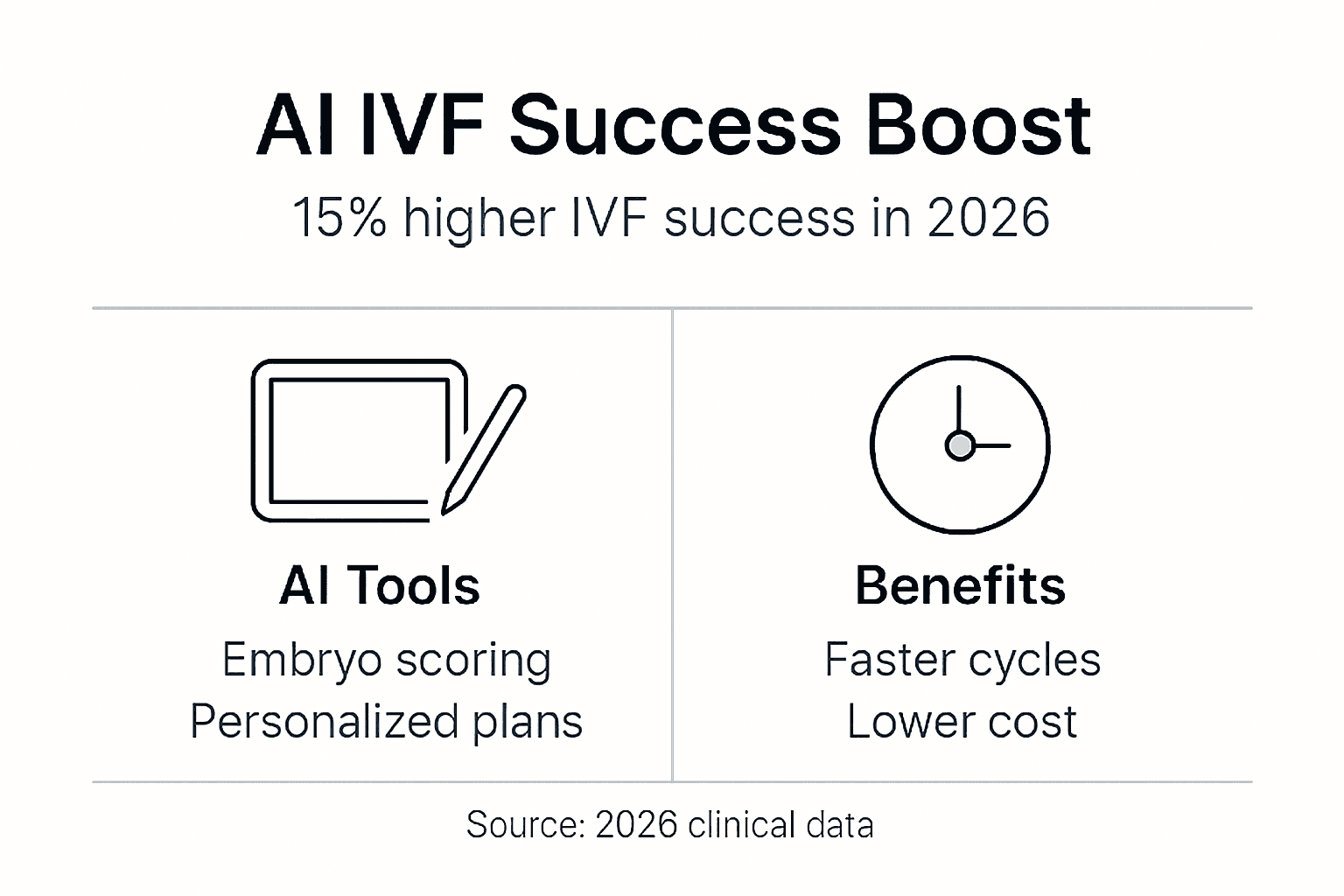
Artificial intelligence is revolutionizing reproductive medicine, boosting IVF pregnancy rates by up to 15% while cutting treatment timelines from months to weeks. If you’re exploring fertility treatments, understanding how AI tools work and where they add value can help you make smarter, faster decisions. This guide breaks down the science, benefits, and practical considerations of AI-enhanced fertility care.
Table of Contents
Key takeaways
Point | Details |
AI embryo scoring | Machine learning analyzes time-lapse images to predict embryo viability with 85-90% accuracy, improving IVF outcomes. |
Personalized protocols | AI integrates your genetic and clinical data to tailor hormone stimulation, reducing side effects and boosting egg yield. |
Faster, cheaper care | AI-driven pathways shorten treatment from 3-6 months to as little as 2 weeks, cutting costs by 20-30%. |
Supports clinicians | AI acts as a decision-support tool, enhancing but never replacing your doctor’s expertise and judgment. |
Ethical considerations | Data privacy, algorithm transparency, and human oversight remain critical when choosing AI-enhanced fertility clinics. |
Introduction to fertility AI tools
Fertility AI tools use machine learning algorithms and data analytics to optimize every stage of reproductive treatment. These technologies analyze vast datasets from embryo images, hormone levels, genetic profiles, and clinical histories to make predictions and recommendations that improve outcomes.
Common applications include:
Embryo selection and viability scoring during IVF
Personalized ovarian stimulation protocols for egg freezing
Automated semen analysis for male fertility diagnostics
Predictive modeling for treatment success rates
Traditional fertility treatments often involve long wait times, redundant testing, and trial-and-error approaches. Women under 40 seeking efficient care face uncertainty about which protocols will work best for their unique biology. AI addresses these challenges by delivering fertility AI protocols that adapt in real time to your body’s responses.
By analyzing patterns invisible to the human eye, AI reduces guesswork. You get a treatment plan tailored to your biology, not a one-size-fits-all approach. This data-driven precision means fewer failed cycles, lower medication doses, and faster paths to pregnancy or egg preservation.
The shift from reactive to proactive care transforms the patient experience. Instead of waiting months for results and adjustments, AI enables dynamic decision-making throughout your cycle. This responsiveness is especially valuable for younger patients with good ovarian reserve who want to maximize efficiency without sacrificing quality.
How AI enhances embryo selection and scoring
Embryo selection is the most critical decision in IVF. Choosing the healthiest embryo dramatically increases your chances of pregnancy. Traditional methods rely on embryologists manually grading embryos at specific time points, a subjective process prone to human error and inconsistency.
AI revolutionizes this by continuously monitoring embryos through time-lapse imaging. Sophisticated algorithms analyze thousands of data points, including cell division timing, fragmentation patterns, and morphological changes. AI algorithms can analyze time-lapse images of embryos to predict viability with accuracy rates up to 85-90%, significantly improving embryo selection compared to manual assessment.

Here’s how AI embryo scoring outperforms traditional methods:
Method | Accuracy | Monitoring | Consistency | Bias Risk |
Traditional grading | 60-70% | Periodic snapshots | Varies by embryologist | High (subjective) |
AI-assisted scoring | 85-90% | Continuous time-lapse | Standardized algorithms | Low (data-driven) |
Key advantages of AI embryo analysis:
Continuous monitoring detects subtle developmental patterns missed by periodic checks
Machine learning identifies complex viability markers beyond human perception
Standardized scoring eliminates inter-observer variability between embryologists
Predictive models account for multiple variables simultaneously
The clinical impact is substantial. Clinics using AI IVF success rates report higher pregnancy rates per transfer and fewer miscarriages. By selecting the embryo with the highest implantation potential, you reduce the number of transfers needed and shorten your journey to pregnancy.
Looking ahead, the future of AI embryo selection includes even more sophisticated analysis integrating genetic screening data and maternal factors.
Pro Tip: Ask your clinic if they use AI embryo scoring validated by peer-reviewed studies. Not all AI tools are equal, and transparency about accuracy rates matters.
Personalization of fertility treatment through AI
Your body is unique, and cookie-cutter treatment protocols often lead to suboptimal results. AI personalizes every aspect of your fertility care by analyzing your specific genetic markers, hormone levels, age, ovarian reserve, and medical history.
For ovarian stimulation, AI algorithms predict how you’ll respond to different medication protocols. Instead of starting with standard doses and adjusting after seeing results, AI calculates the optimal starting point. This precision reduces the AI role in egg freezing risks like ovarian hyperstimulation syndrome while maximizing the number of quality eggs retrieved.
Personalized egg freezing protocols consider:
Your baseline hormone levels and antral follicle count
Genetic factors affecting medication metabolism
Real-time monitoring data during stimulation cycles
Historical outcomes from patients with similar profiles
The result? Fewer side effects, better egg quality, and more efficient cycles. Women under 40 with good ovarian reserve benefit most, as AI fine-tunes protocols to their naturally robust response patterns.
Dynamic protocol adjustments represent another breakthrough. Traditional treatments follow rigid schedules, but AI continuously analyzes your body’s response and recommends real-time changes. If your follicles grow faster than expected, AI recalculates medication timing to prevent premature ovulation. This adaptability is central to the AI impact on fertility treatments.
Modern fertility clinic AI technology integrates multiple data streams. Your treatment becomes a feedback loop where each measurement refines the next decision, accelerating success while minimizing physical and financial stress.
How AI reduces fertility treatment duration and cost
Traditional IVF timelines stretch 3 to 6 months from initial consultation to embryo transfer. Multiple appointments, redundant tests, and waiting periods between steps consume time and money. AI streamlines this process dramatically.
AI-accelerated pathways can compress treatment to as little as 2 weeks. How? By eliminating unnecessary procedures and optimizing scheduling. Machine learning identifies which diagnostic tests provide the most value for your specific situation, skipping redundant screens that rarely change treatment decisions.
Cost savings follow naturally. Fewer appointments mean lower clinic fees. Reduced medication waste from precise dosing cuts pharmacy bills. Faster cycles mean less time off work and fewer emotional ups and downs. Studies show AI cost-effective fertility solutions deliver 20-30% savings compared to traditional care.
Treatment Aspect | Traditional Timeline | AI-Accelerated Timeline | Traditional Cost | AI-Enhanced Cost |
Initial consultation to start | 4-6 weeks | 3-7 days | $500-800 | $300-500 |
Diagnostic testing | 2-4 weeks | 1 week | $1,500-2,500 | $800-1,200 |
Stimulation cycle | 10-14 days | 8-12 days | $4,000-6,000 | $3,000-4,500 |
Monitoring visits | 6-8 visits | 4-5 visits | $1,200-1,600 | $600-900 |
Total timeline | 12-24 weeks | 2-4 weeks | $7,200-10,900 | $4,700-7,100 |
The efficiency gains compound. Shorter cycles mean you can attempt additional rounds if needed within the same calendar year. For women under 40 banking eggs before age-related decline accelerates, speed matters.
Pro Tip: Ask clinics about their average time from consultation to procedure. Transparent practices that use AI should provide specific timelines, not vague estimates.
AI applications beyond female fertility: male fertility diagnostics
Male fertility factors contribute to roughly half of all infertility cases, yet diagnostic methods have lagged behind advances in female care. AI is closing this gap with automated semen analysis that surpasses manual laboratory techniques.
Traditional semen analysis involves lab technicians manually counting sperm under microscopes and subjectively assessing motility and morphology. Results vary between technicians and labs, creating inconsistency that complicates treatment planning.
AI tools applied in male fertility testing can analyze semen parameters automatically with high reliability, improving diagnostic consistency and identifying subtle issues missed manually. Computer vision algorithms trained on thousands of samples detect abnormalities in sperm shape, movement patterns, and DNA integrity that human observers overlook.
Key improvements in male fertility AI diagnostics:
Automated cell counting eliminates human counting errors
Motility tracking analyzes swim patterns frame by frame
Morphology assessment identifies subtle structural defects
DNA fragmentation prediction without additional invasive tests
This precision helps explain unexplained infertility cases. When standard tests show “normal” results but couples still struggle to conceive, AI often reveals borderline issues that tip the scales. Identifying these factors early guides treatment decisions, whether that means lifestyle changes, medication, or proceeding directly to ICSI.
The complementary role of male and female fertility AI creates a comprehensive diagnostic picture. Couples benefit from parallel analysis that pinpoints the true source of challenges, avoiding wasted time on treatments targeting the wrong issue.
Common misconceptions about AI in fertility
As AI adoption grows, myths and misunderstandings create unrealistic expectations or unwarranted fears. Let’s separate fact from fiction.
Myth: AI guarantees pregnancy success. Reality: AI improves your odds by optimizing decisions, but biology remains complex. Even the healthiest embryo selected by AI may not implant due to factors like uterine receptivity or immune responses. AI increases success rates by 10-15%, which is significant but not a guarantee.
Myth: AI replaces fertility doctors. Reality: Contrary to popular belief, AI does not replace clinicians but acts as a decision-support tool enhancing human expertise in fertility treatments. Your doctor interprets AI recommendations within the context of your full medical picture, emotional needs, and personal preferences. The AI role in fertility treatments amplifies human judgment rather than replacing it.
Myth: AI eliminates human error. Reality: AI reduces certain types of errors like miscounting cells or missing subtle patterns. However, AI systems can fail if trained on biased data or programmed with flawed assumptions. Human oversight catches these issues and ensures AI recommendations make clinical sense.
Key facts to remember:
AI provides probabilistic predictions, not certainties
Algorithm quality varies widely between systems
Clinical judgment remains essential for safe care
Transparency about AI limitations builds trust
Understanding these realities helps you advocate for yourself. Ask questions about how AI integrates with human decision-making at your clinic. The best programs combine cutting-edge technology with experienced clinicians who explain recommendations clearly.
Ethical and practical limitations of AI in fertility care
AI brings powerful benefits but raises important ethical questions every patient should consider. Data privacy tops the list. AI systems require access to your sensitive medical information, genetic data, and embryo images. How is this data stored? Who can access it? What happens if you switch clinics?
Reputable clinics maintain strict privacy protocols:
Encrypted data storage and transmission
Limited access restricted to your care team
Clear consent forms explaining data usage
Options to withdraw consent and delete records
Algorithm transparency matters too. Some AI systems operate as “black boxes” where even developers can’t fully explain how decisions are reached. This opacity creates accountability challenges. If an AI recommendation leads to a poor outcome, who bears responsibility?
Practical limitations include:
AI accuracy depends on training data quality and diversity
Rare medical conditions may lack sufficient data for reliable predictions
Technical failures or software bugs can occur
Not all AI tools undergo rigorous clinical validation
Ethical concerns around decision-making deserve attention. Should AI influence whether to transfer one embryo or two? Who decides if AI recommends genetic screening you hadn’t planned? These choices touch on deeply personal values about family building.
Human oversight remains non-negotiable. Your doctor should review all AI recommendations, consider factors the algorithm can’t capture, and discuss options with you before proceeding. Automated decision-making without clinician review crosses ethical lines.
When evaluating clinics, ask about:
Data security certifications and privacy policies
AI system validation studies and peer-reviewed evidence
How clinicians incorporate AI into treatment decisions
Your rights to understand and question AI recommendations
Practical considerations for choosing AI-enhanced fertility care
Ready to explore AI-enhanced fertility treatment? Here’s how to evaluate clinics and make informed decisions that balance technology with personalized human care.
Verify AI technology credentials. Ask for specifics about which AI systems the clinic uses and whether they’ve been validated in peer-reviewed studies. Generic claims about “advanced technology” aren’t enough. Request outcome data showing how AI has improved success rates for patients with profiles similar to yours.
Assess transparency and communication. Top clinics explain how AI fits into your treatment plan in plain language. They disclose limitations honestly and never pressure you to accept AI-driven recommendations without discussion. Look for practices offering accessible support like WhatsApp messaging or patient portals.
Evaluate the balance of technology and human touch. AI should enhance, not replace, personalized care from experienced doctors and nurses. During consultations, notice whether staff listen to your concerns or rush through standardized protocols. The best clinics combine algorithmic precision with empathy.
Compare costs and value. AI-enhanced care should cost less than traditional treatment due to efficiency gains. Be suspicious of clinics charging premium prices solely for AI access. Request itemized cost breakdowns and ask which expenses AI helps reduce.
Review patient testimonials and outcomes. Look beyond marketing materials to independent reviews and success rate data. Clinics genuinely confident in their AI tools publish transparent statistics broken down by age group and treatment type.
Confirm data privacy protections. Read privacy policies carefully and ask questions about data handling, storage duration, and your rights to access or delete information. Ensure the clinic complies with HIPAA and other relevant regulations.
Consider location and convenience. Even with AI accelerating timelines, you’ll still need clinic visits. Evaluate whether the location fits your schedule and whether travel requirements are manageable.
Pro Tip: Request a list of questions to ask during your consultation about AI validation, outcome data, and how technology integrates with human decision-making. Clinics comfortable with scrutiny typically provide better care.
Discover AI-integrated fertility care at Aurea Fertility Center
Aurea Fertility combines cutting-edge AI technology with personalized care designed for women under 40 seeking efficient, affordable treatment. Our AI integrated fertility clinic reduces treatment timelines from months to as little as two weeks while cutting costs by up to 40%. We use validated AI protocols for embryo selection, personalized stimulation, and male fertility diagnostics to maximize your success rates. With 24/7 WhatsApp support and transparent pricing, we make advanced reproductive care accessible. Learn more about Aurea Fertility Center and download our fertility patient checklist 2026 to start your journey with confidence.
Frequently asked questions about fertility AI tools
Does AI guarantee pregnancy success?
No, AI improves your probability of success but cannot guarantee pregnancy. Even optimally selected embryos may not implant due to factors like uterine receptivity, immune responses, or unpredictable biological variables. AI typically boosts success rates by 10-15% compared to traditional methods.
Can AI replace my fertility doctor?
AI acts as a decision-support tool that enhances your doctor’s expertise but never replaces clinical judgment. Your physician interprets AI recommendations within your full medical context, discusses options with you, and makes final treatment decisions. Human oversight ensures safety and personalization.
Is AI embryo scoring reliable?
Yes, validated AI embryo scoring systems achieve 85-90% accuracy in predicting viability, significantly outperforming manual grading. However, reliability varies between systems, so ask your clinic about peer-reviewed validation studies and outcome data for their specific AI tools.
How does AI affect treatment cost and timeline?
AI can reduce treatment duration from 3-6 months to as little as 2 weeks by eliminating unnecessary tests and optimizing scheduling. Cost savings typically range from 20-30% due to fewer appointments, reduced medication waste, and improved efficiency. Ask clinics for specific cost comparisons.
Are there privacy risks with AI in fertility care?
AI requires access to sensitive medical and genetic data, creating privacy considerations. Reputable clinics use encrypted storage, limit data access to your care team, and comply with HIPAA regulations. Always review privacy policies and ask about data handling, retention, and your rights to access or delete information.
What should I ask clinics about their AI technology?
Inquire about which specific AI systems they use, peer-reviewed validation studies, outcome data for patients like you, how clinicians incorporate AI into decisions, data privacy protections, and any additional costs for AI-enhanced care. Transparent clinics provide detailed answers without hesitation.
Recommended
Comments